Top 5 Hyros Alternative Marketing Reporting Software 2026
Explore 5 top Hyros alternative marketing reporting software. Compare options to find the best fit for your data analysis and reporting needs.
Matching marketing reporting across channels and linking campaigns to revenue is slowed by software limits or technical barriers. Many platforms either restrict features behind complex pricing, require technical onboarding, or lack creative and attribution tools in one place. This comparison sets price, compliance, and creative reporting side by side so marketers can choose the Hyros alternative that suits their team.
MyContentLab
At a Glance
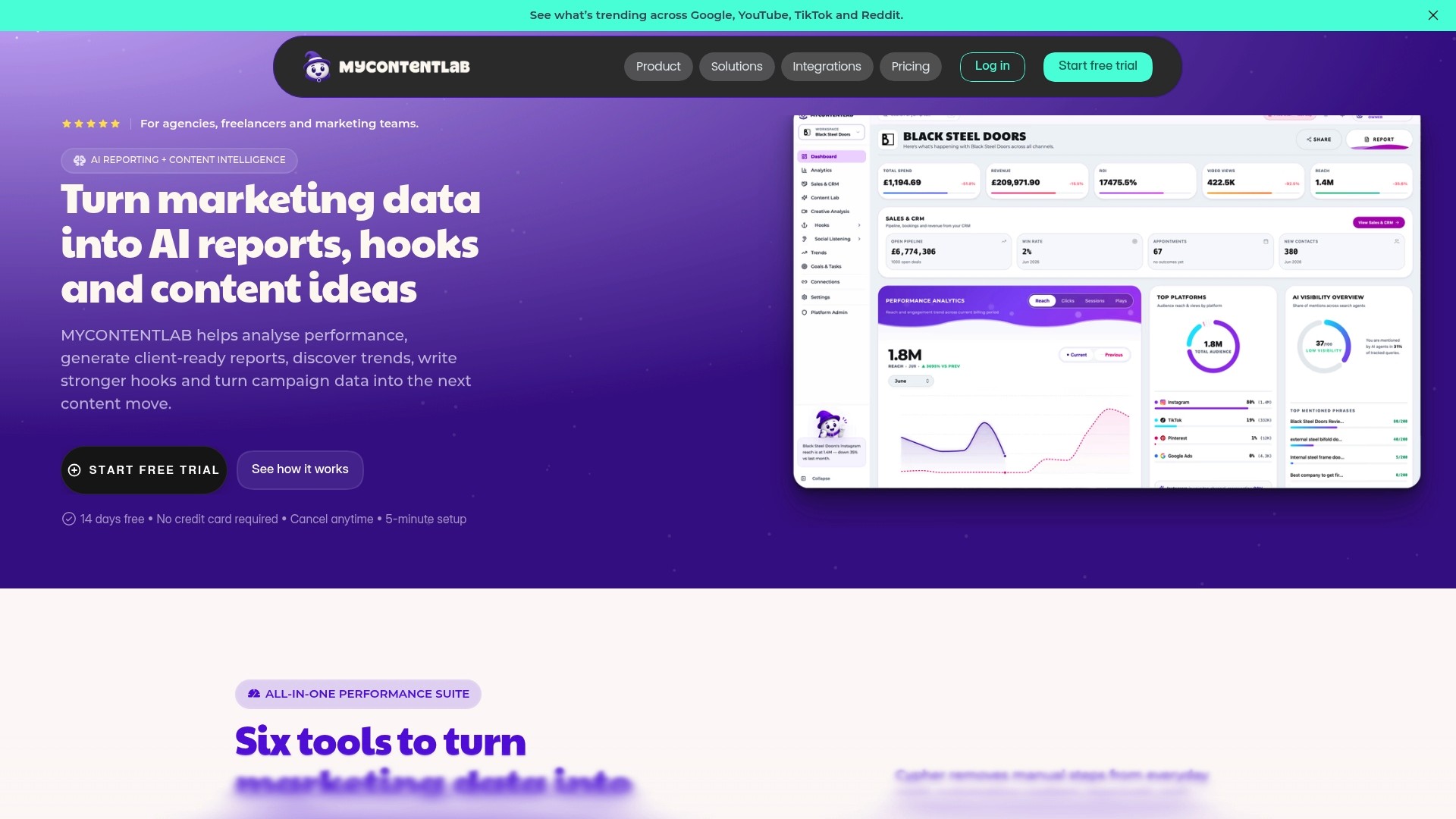
Plans start at £47 for creators and rise to £497 for enterprise customers. This pricing range matches the product's focus on agencies, freelancers, and in house teams. MyContentLab turns scattered campaign metrics into client ready reports while generating content ideas and short video hooks from performance data.
Core Features
MyContentLab delivers AI driven campaign reporting and concise summaries, plus automated client reports that can include branding in white label plans. It generates content ideas and hooks for short videos, ads, and social posts, and supports content planning and workflow organisation. Cross channel performance comparison and AI driven creative feedback help teams compare periods and explain results.
Key Differentiator
An integrated AI driven platform that combines performance analytics, content ideation, and social listening tailored for marketing teams. That mix lets teams move from numbers to creative options within the same tool. Social listening and trend analysis are listed as coming soon, so the platform aims to close reporting and creative gaps under one roof.
Pros
MyContentLab automates much of the manual reporting work. That saves time when producing monthly client deliverables and reduces repetitive editing of slides and summaries. Branded white label plans and custom domain options let agencies deliver client ready reports that match brand guidelines. AI generated summaries and creative feedback help explain performance to clients and inspire new content directions.
Cons
Social listening and trend features are marked as coming soon, so these capabilities may not be fully available for immediate campaign monitoring.
Who It's For
MyContentLab suits marketing agencies, social media managers, content creators, and freelancers who manage multiple clients or brands. It works well for teams that must produce regular client reports and also want content ideas tied to real campaign performance. Small one person consultancies may find higher tiers expensive depending on needs.
Unique Value Proposition
AI generated content ideas and short video hooks derived from actual campaign performance. That feature reduces the time spent moving from analytics to creative briefs. Combined with automated, brandable client reports and unlimited client options on higher plans, the platform lets agencies spend less time formatting and more time on strategy and creative testing.
Real World Use Case
A digital marketing agency uses MyContentLab to automate monthly client reports and to show which creative variants drove engagement. The team pulls cross channel comparisons, exports white label reports for clients, and uses the generated hooks to brief video editors. This process frees the account team to focus on campaign strategy and testing.
Pricing
Flexible monthly subscription plans start at £47 for creators and scale to £497 for enterprise. Higher tiers offer white label branding, a custom domain, and unlimited clients, while some advanced modules may require an upgraded plan.
Website: https://mycontentlab.ai
Tracify

At a Glance
Tracify's marketing materials state up to 40% more relevant data points compared with traditional methods. According to the company, Tracify operates cookieless and claims GDPR compliance while hosting anonymised data in Germany. The product targets online retailers and lead generators that need full customer journey visibility.
Core Features
Tracify combines AI Matching, AI Attribution, and Hybrid Tracking to resolve user identity and measure impact across channels. Real-time dashboards appear in both a browser extension and an API, with views for customer journeys, creative performance, influencer tracking, profit and loss, and ad manager metrics. The stack also supports marketing overview reports for quick optimisation.
Key Differentiator
The vendor advertises a patented hybrid tracking technology that works without cookies and without relying on browser consent. That approach aims to preserve cross-device and cross-channel linkage while keeping personally identifiable data anonymised. For teams that must balance privacy rules with attribution needs, the hybrid method is the product's central claim.
Pros
Cookieless, consent-independent tracking reduces data loss from browser restrictions, which supports steadier attribution for multichannel campaigns. Tracify reports built-in privacy compliance for GDPR and CCPA and stores anonymised data in Germany, a detail that matters to EU-based advertisers. Real-time dashboards and extension access let you react quickly to performance shifts. The platform lists numerous native connections, simplifying feed and ad spend reconciliation.
Cons
Does not support app tracking or lead management outside e-commerce and online lead generation. These limits use for mobile-app-first businesses.
Users report a learning curve and need for onboarding support due to setup complexity. Expect implementation effort.
Initial deployment may require technical knowledge or professional support to get matching and attribution tuned correctly.
When It May Not Fit
If your primary business is mobile apps or offline lead pipelines, Tracify is unlikely to meet your tracking needs. Small teams without developer support will struggle with the setup and maintenance. Agencies that need built-in lead management workflows outside e-commerce should look elsewhere.
Notable Integrations
Shopify
Shopware 6
WooCommerce
WordPress
Leadpages
ActiveCampaign
Klaviyo
Mailchimp
Google Ads
Meta Platforms
TikTok
Criteo
Outbrain
Bing Ads
Snapchat
WhatsApp
Custom shop systems
Who It's For
Performance marketers, digital agencies, e-commerce teams, and lead generation companies that need privacy-focused, cross-channel attribution will find Tracify relevant. The product suits teams that can allocate technical resources for implementation and want visibility across ads, email, and on-site behaviour.
Real World Use Case
An e-commerce brand used Tracify to attribute conversions across Google, Meta Platforms, TikTok, and email campaigns. The team used the platform's journey dashboards to reallocate ad spend and improve return on ad spend over successive campaigns.
Pricing
Tracify lists pricing as €€€. Exact tiers and per-feature fees are not publicly listed and require a vendor conversation for a tailored quotation.
Website: https://tracify.ai
Admetrics
At a Glance
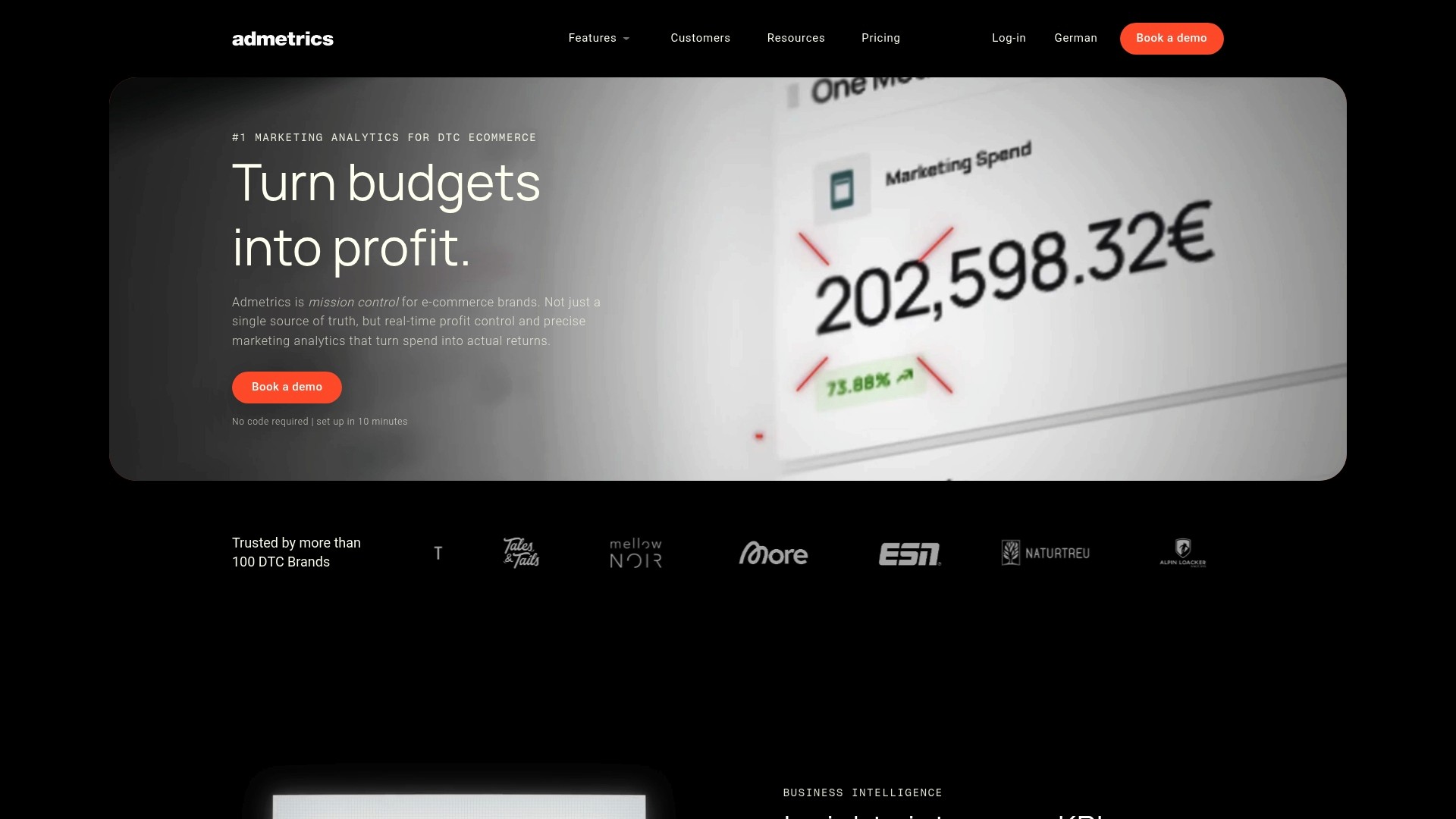
Admetrics reports being trusted by over 100 DTC brands. The vendor advertises GDPR and CCPA compliance for data privacy. The platform claims a setup that takes 10 minutes without code and focuses on converting ad spend into profit with live profit control and attribution.
Core Features
Admetrics combines live profit control with a unified dataset that exposes 150+ customizable KPIs for marketing and sales. It tracks customer journeys and attribution, offers marketing mix modelling, and uses a Bayesian experimentation engine to accelerate testing and learning. The platform also supports server to server data pushback to improve ad network reporting.
Key Differentiator
The strongest single angle is the pairing of live profit monitoring with AI driven budget optimisation and a no code setup in 10 minutes. That mix lets teams view profit and performance together and adjust budgets from the same dashboard. The approach prioritises profit rather than clicks or last click attribution alone.
Pros
Admetrics makes connecting Shopify and major ad platforms straightforward, which helps you see sales and ad spend in one place. The platform includes advanced tools such as marketing mix modelling and an AI driven budget optimiser, so you can test allocation strategies and measure offline impact. Setup speed and the focus on profit metrics reduce the time your team spends on manual reconciliations.
Cons
Trustpilot reviews suggest a learning curve with the advanced analytics features. Training or an analyst may be needed to get full value.
Pricing follows a volume model that can raise costs during months with heavy ad spend. High spend months may mean higher fees.
Public pricing details are limited, so you will likely need to contact sales for customised tiering and exact quotes.
When It May Not Fit
Admetrics mostly suits high volume e commerce stores and marketing teams with significant ad budgets. Smaller brands or low frequency sellers will likely find the feature set more than they need. Teams that prefer flat simple pricing may dislike the volume based cost model. If you have minimal analytics resources, advanced experimentation tools may feel overwhelming.
Who It's For
The product fits marketing managers and e commerce teams running scalable Shopify stores who want continuous profit visibility. It suits teams that run multi channel ad programmes and want attribution plus budget allocation in one place. It also fits shops that plan to experiment with marketing mix modelling and test budget scenarios.
Real World Use Case
A direct to consumer brand connects Shopify, Meta, Google, and TikTok to Admetrics, then watches LTV and profit per campaign in real time. The team uses the AI driven budget optimiser to shift spend away from low profit audiences and into higher return segments. Over weeks the brand gains clearer ROAS signals and tighter budget controls.
Pricing
Pricing starts at $399/month and includes $20,000 of ad spend. Additional spend is charged at 1.5% above the included allowance. Exact tiering and enterprise options require direct contact with sales for a custom quote.
Website: https://admetrics.io
AnyTrack
At a Glance
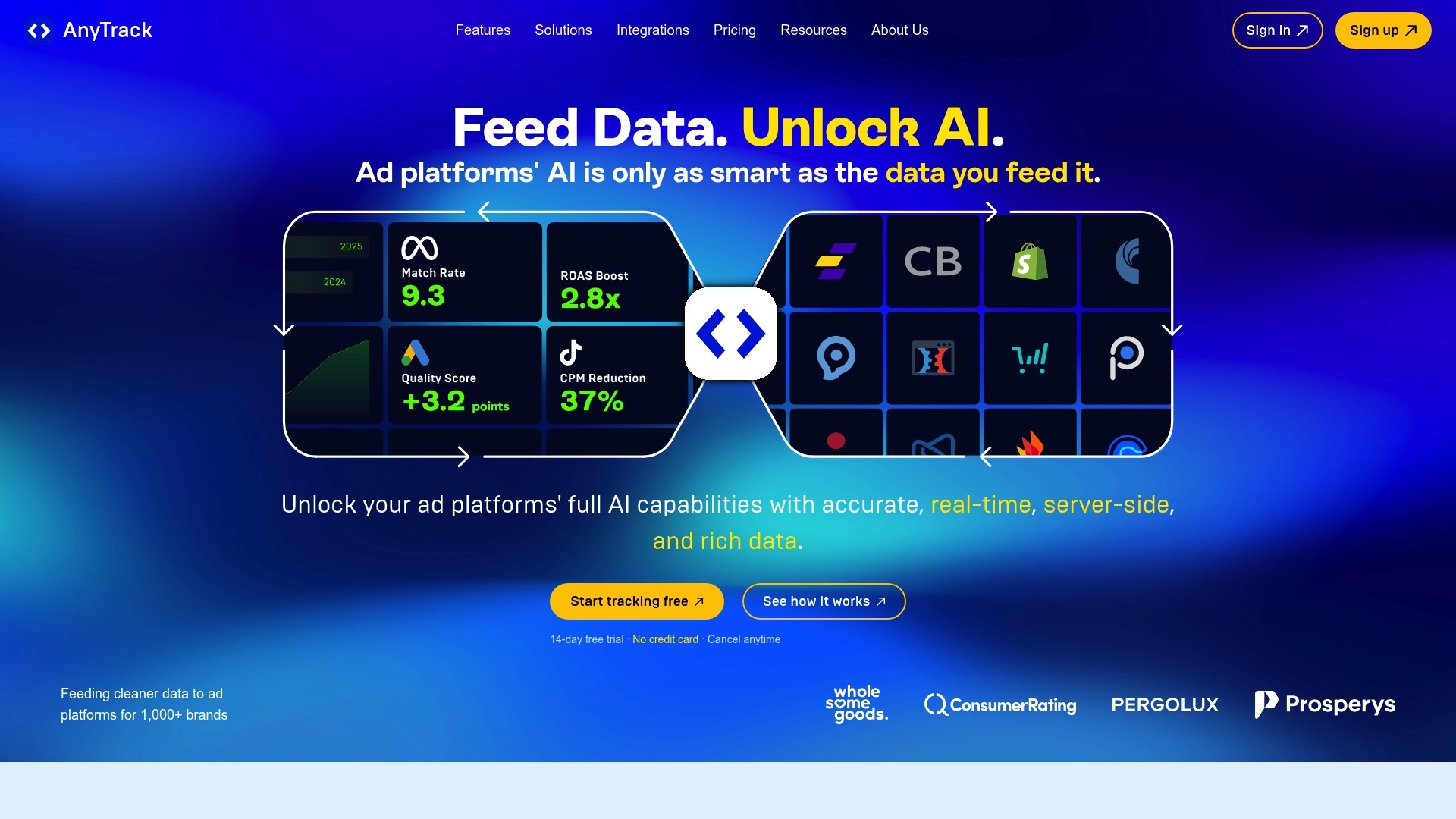
AnyTrack integrates with over 300 platforms, including major ad networks, CRMs, and e-commerce stores. The vendor advertises server-side conversion tracking that aims to recover conversions blocked by browsers and ad blockers. That approach targets ad performance losses caused by privacy changes such as iOS 17.
Core Features
AnyTrack centralises ad platform signals and feeds them to multiple destinations from a single tag, while capturing conversion events across domains and devices. It collects first-party data and orchestrates that data to enrich platform optimisation and reporting. The product also offers real-time analytics and revenue-focused reporting to measure true ROAS across channels.
Key Differentiator
AnyTrack’s standout feature is its ability to feed enriched, server-side conversion data to several ad platforms in real time from one tag. That mechanism reduces reliance on client-side pixels and helps ad engines receive more complete signals for bidding and audience creation. The single-tag model simplifies multi-channel data flow for teams that manage many ad accounts.
Pros
AnyTrack automates data collection and routes signals to multiple ad platforms from one installation, which lowers tag fragmentation and reduces duplication in reporting. It improves attribution accuracy where client-side data is lost, so advertisers see more consistent revenue mappings across Facebook Ads, Google Ads, and TikTok Ads. The platform supports privacy-friendly first-party capture and server-side processing, which helps maintain conversion visibility despite browser restrictions. Finally, the breadth of integrations makes it practical for e-commerce teams using Shopify or WooCommerce and agencies managing affiliate and ad networks.
Cons
Customer support can be slow or inconsistent for some users, which affects urgent troubleshooting.
The setup and integration workflows are complex for teams without prior tracking experience, requiring technical resources.
Pricing may feel steep for very small businesses and startups on a tight budget.
When It May Not Fit
If your team lacks engineering support, the initial integration and server-side configuration will be a barrier. Organisations with minimal ad spend or just a single campaign channel may not see enough value to justify the cost. If you need plug-and-play reporting without tag work, this product may demand more implementation time than you want. Performance also depends on correct tag placement and configuration.
Notable Integrations
Facebook Ads, Google Ads, TikTok Ads, Microsoft Ads
Shopify, WooCommerce
ClickBank, HubSpot
Who It's For
Anyone running multi-channel paid media who needs more complete conversion data. Typical users are marketers, ad agencies, and e-commerce stores that manage several ad accounts and require privacy-compliant server-side tracking. It fits teams that can allocate technical resources to implement server-side tags and map events.
Real World Use Case
An e-commerce brand tracks customer journeys from ad click to purchase across Facebook, Google, and TikTok. AnyTrack captures server-side conversions, enriches signals with first-party data, and sends those signals back to ad platforms in real time. That flow supports smarter bidding and clearer ROAS measurements.
Pricing
Paid plans use tiered pricing based on sessions and websites, with plans starting at £100/month and a 14-day free trial. Enterprise tiers and overage rules are available but not publicly listed in detail.
Website: https://anytrack.io
Admira

At a Glance
Built-in cookieless tracking sits alongside automated video and static ad generation, letting teams test creative while preserving user privacy. The vendor advertises GDPR and CCPA compliance. Admira targets marketing teams that need multi-touch attribution and creative automation under one roof.
Core Features
Admira combines AI-powered ad creation with automated optimisation, letting teams produce and iterate video and static creative at scale. It provides multi-touch attribution and marketing analytics, plus unified data integration and real-time tracking for cross-channel performance. Customisable dashboards, chat-based analysis, and AI recommendations help surface trends without heavy engineering work.
Key Differentiator
Admira centres its offer on being an all-in-one AI platform that links creative automation to attribution and privacy-first tracking. That combination suits organisations running multiple marketing stacks who want to manage creatives, measurement, and compliance from a single environment. The approach reduces the number of separate tools needed to connect ad performance to revenue.
Pros
The platform bundles creative production and measurement, so paid media teams can reduce external production costs and speed campaign iteration. Custom dashboards and chat-style queries deliver fast access to cross-channel performance, which helps analysts answer questions without exporting data. The privacy features and cookieless tracking support modern regulatory requirements, and the product claims GDPR and CCPA compliance on its site.
Cons
Pricing and feature breadth may feel complex for smaller teams. Many small teams will need to weigh cost against immediate returns.
No widely advertised free tier or trial means initial evaluation may require a paid commitment. That raises the barrier for rapid testing.
There is a learning curve for teams unfamiliar with AI-driven workflows. Some buyers report the need for dedicated onboarding or custom setup.
Full benefits require configuration for complex stacks, which can lengthen time to value.
When It May Not Fit
If you are a solo entrepreneur or a very small marketing team, Admira may be more than you need given the pricing and breadth of features. Teams with only simple single-channel campaigns will not benefit from the multi-stack capabilities. Organisations seeking an out-of-the-box, zero-configuration tool will find setup and initial customisation time-consuming.
Who It's For
Mid-sized to large marketing teams, growth managers, and data analysts running multiple advertising platforms will gain most from Admira. It fits B2B SaaS marketers and ecommerce brands that require attribution across touchpoints and want to combine creative production with measurement. The platform suits teams prepared to invest in setup and onboarding.
Real World Use Case
A B2B SaaS company connects its ad accounts and CRM, then uses Admira to attribute revenue across channels. The team automates ad creative, tests variations, and reassigns budget toward channels that the reports identify as driving pipeline. That workflow accelerates campaign iterations and clarifies spend decisions.
Pricing
Pricing varies by plan, with a stated Starter tier starting at $199/month, a Growth tier at $399/month, and custom enterprise pricing for larger implementations. Exact feature caps and seat limits depend on the selected plan and any bespoke enterprise contract.
Website: https://getadmira.com
Comparison of alternatives
Marketing reporting software offers diverse functionality, catering to specific team needs and priorities across different scenarios.
Tailored team outcomes
The discussed solutions vary in their unique offerings. For instance, Tracify excels in privacy-focused cross-channel tracking using its patented hybrid tracking technology, which ensures GDPR compliance. Conversely, Admetrics offers no-code setup for live profit control alongside Bayesian experimentation tools, ideal for high-budget e-commerce operators. Meanwhile, MyContentLab combines AI-driven campaign performance analysis with creative recommendations, assisting marketing agencies in bridging analytics with strategic ideation workflows.
Scalability and accessibility considerations
Setup complexity and pricing structures influence product viability depending on the team's technical expertise and budget. Tracify and AnyTrack experienced high marks for integration and functionality depth but required more significant technical resources for initial implementation. This characteristic may deter smaller teams without dedicated technical support. In contrast, MyContentLab focuses on automating reporting reducing manual workloads, accommodating small to mid-size agencies seeking efficiency.
Best fit
For marketing agencies creating branded reports alongside viable campaign scenarios, MyContentLab effectively aligns creative ideation with productivity needs.
Tracify suits privacy-prioritising e-commerce teams requiring thorough attribution insights across multiple touchpoints.
High-spend advertisers seeking profit-driven ad adjustment and cutting optimisation tools will align well with Admetrics.
AnyTrack addresses technical aggregators requiring precise signal feed-backs for managing distributed marketing operations.
Our pick
MyContentLab emerges as the leading choice for organisations prioritising streamlined client reporting and bridging analytics with creative ideation workflows. Featuring performance-analyzing AI and an integrated ideation platform, it aids agencies in delivering detailed, quantifiable results efficiently. However, teams without multifaceted reporting needs might better explore alternatives like Tracify for its highly focused data-compliant approaches.
Deciding between marketing tools depends on the features, integrations, and pricing that best match your team's needs. This table highlights key details of several options.
Product | Core Feature | Key Differentiator | Pricing | Notable Limitation |
|---|---|---|---|---|
Mycontentlab | AI-driven reporting and creative workflows | Combines analytics and content ideation | £47–£497/month | Social listening features marked as coming soon |
Tracify | Cookieless customer journey attribution | Patented hybrid tracking technology | Price not published | Focused on online retailers; requires technical setup |
Admetrics | Live profit control paired with multi-channel tracking | No-code setup in 10 minutes | $399+/month | Cost increases during high ad spend periods |
AnyTrack | Server-side tracking for multi-platform signals | Single tag supports cross-channel data enrichment | £100+/month | Requires engineering support for setup |
Admira | AI-powered ad creation and multi-touch attribution | Creative automation linked to attribution | $199+/month | Initial evaluation requires paid commitment |
How Can Marketing Teams Overcome Reporting Challenges Beyond Traditional Hyros Alternatives?
Marketing agencies, freelancers, and in-house teams often face difficulties managing disparate campaign metrics and generating content ideas linked to real performance. Mycontentlab offers a tailored solution that automates complex reporting tasks, converting scattered data into clear, client-ready reports with white-label options. Users also gain AI-generated content ideas and video hooks based on actual campaign results, reducing the gap between numbers and creative briefs.
Key benefits include:
Eliminating repetitive manual reporting
Creating reports customised to brand guidelines
Generating creative prompts directly from performance data
Visit Mycontentlabto see how it can simplify reports and inspire fresh content strategies. Sign up to generate your next branded client report in minutes and let your team focus on campaign growth rather than formatting.
FAQ
What makes MyContentLab suitable for marketing agencies?
MyContentLab automates manual reporting tasks, making it ideal for marketing agencies. The platform generates client-ready reports and offers features like white label branding and AI-generated summaries, which save time and improve efficiency. Agencies can thus focus more on strategy and creativity instead of tedious reporting processes.
How does MyContentLab compare to Tracify in terms of tracking capabilities?
Tracify offers a patented hybrid tracking technology that works without cookies, providing an advantage for privacy-focused marketing needs. MyContentLab, while it excels in content ideation and performance reporting, does not have the same level of hybrid tracking capabilities. For agencies focusing on creative development and content strategy, MyContentLab is the better fit.
What specific features does MyContentLab provide for content creators?
MyContentLab generates content ideas and hooks for ads and social media posts, helping content creators produce engaging materials quickly. This functionality allows creators to tie their content directly to campaign performance metrics, thus streamlining their workflow effectively.
Can I use MyContentLab for client report generation?
Yes, MyContentLab excels in automated client report generation, making it perfect for teams that need consistent and quick deliverables. The feature of customisable, white label reports ensures that agencies can present data in line with their branding.
How does the pricing of MyContentLab compare to traditional marketing reporting solutions?
MyContentLab's pricing starts at £47 for creators and goes up to £497 for enterprise solutions, which is competitive compared to many traditional reporting systems that may not offer the same level of automation and flexibility. This range supports different scales of operations, making it accessible for small to large marketing teams.
Recommended


Jul 19, 2026


Search



You can also read
Category
All
Compare
Marketing Reporting
Agency Operations
Content Intelligence
Brand Monitoring
Platform Reporting