Top 5 Marketing Analytics Platforms Alternatives 2026
Compare 5 marketing analytics platforms alternatives to find the best fit for analysing data and optimising campaigns effectively.
Tracking client performance across several marketing channels takes too long when teams use fragmented reporting tools. Manual report assembly and limited integration support waste hours and complicate onboarding for agencies, freelancers, and content teams. This comparison covers price, integration breadth, and workflow strengths so agencies can pick a platform that fits their portfolio size and reporting needs.
Mycontentlab
At a Glance
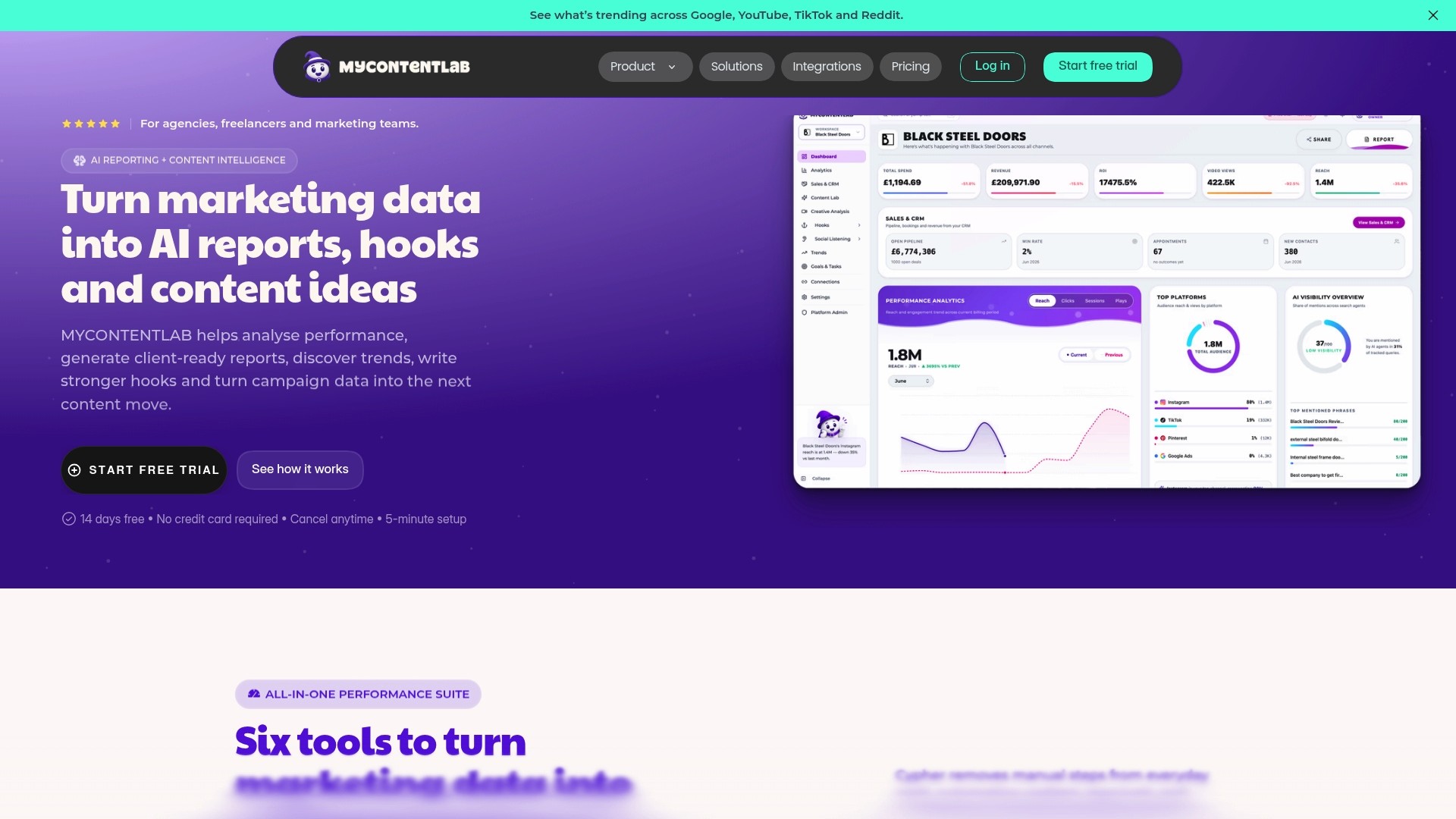
Plans start at £47 and scale to £497 per month, reflecting packages for solo freelancers up to larger teams. The platform turns performance metrics into content ideas, hooks, trend signals and client reports across Google, YouTube, TikTok and Reddit. That pricing spread makes it straightforward to match spend to feature needs.
Core Features
Mycontentlab combines AI performance reporting with content idea generation and trend analysis in a single workspace. The platform produces short summaries, social listening alerts and creative analysis that link back to the originating metrics. Users can generate attention grabbing openings and content strategies from actual channel data.
Key Differentiator
The standout is a single AI powered workspace that links analytics, trend detection, content ideation, hook creation and social listening. Data and creative outputs live together, so teams do not move between separate tools to find a hook or a report chart. That integration reduces manual report assembly and keeps evidence next to recommendations.
Pros
Automating report generation cuts the manual time spent assembling client decks and frees teams to test concepts. The platform supplies content ideas and creative prompts drawn from performance and trend signals, which helps authors start faster. It supports multiple channels and social listening while offering white label options for agency branding. The vendor claims increased productivity and sharper reporting based on real time data.
Cons
Limited third party integration details are available on the website, which may complicate onboarding for teams that rely on niche connectors.
Who It's For
Agencies, freelancers and in house content teams that manage several clients or campaigns will get the most value. Creators who want content ideas tied to performance data also benefit. Teams seeking a single place to turn metrics into briefs and client deliverables will find the workflow useful.
Unique Value Proposition
The platform turns raw performance metrics into content ideas and headline hooks inside the same workspace. That means you can move from a failing post to a fresh brief without exporting charts or rewriting notes. For agencies that bill for creative time, this reduces wasted hours spent translating data into concepts.
Real World Use Case
A digital marketing agency uses Mycontentlab to produce monthly client reports and to mine account data for trend led content ideas. Planners pull hooks directly from the platform, then attach the originating metrics to the client slide. The practice shortens prep time and clarifies why each idea was proposed.
Pricing
Pricing uses flexible tiered plans from £47 to £497 per month, with features and scale aligned to each tier. The vendor does not publish exact feature lists for every tier on the landing page, so teams should request a plan comparison when budgeting.
Website: https://mycontentlab.ai
AgencyAnalytics
At a Glance
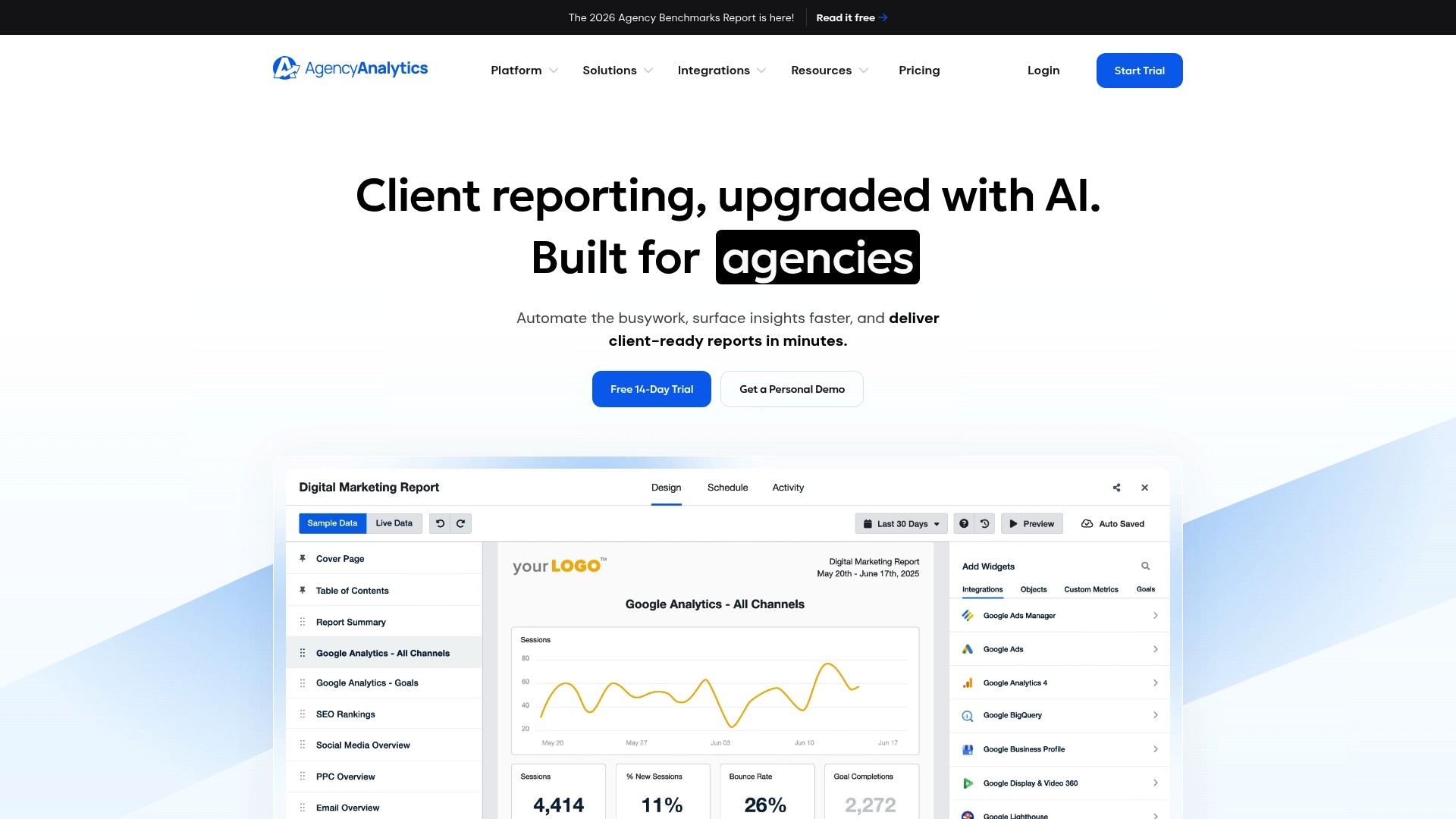
AgencyAnalytics charges $20 USD per client per month, billed annually, with enterprise options and add ons. The vendor reports that thousands of agencies have used the product since 2010. It centres reporting, client portals, and AI insights in one interface.
Core Features
Automated client reporting and white label branding let teams deliver scheduled, branded reports to clients. The platform includes AI powered insights that flag trends, plus benchmarks and forecasting tools for planning. Client portals and custom KPIs help agencies give clients on demand access and measure bespoke targets.
Key Differentiator
The key differentiator is the combination of extensive integrations and AI powered insights. That mix lets agencies pull data across platforms and apply automated analysis without juggling multiple tools. The vendor cites 85+ connectors to support multi client portfolios.
Pros
The platform reduces the time spent on reporting and improves the appearance of client deliverables. It supports 85+ integrations, so agencies can centralise data from marketing platforms into one dashboard. Custom KPIs and client portals make reporting relevant to each client without frequent manual updates. AI insights highlight trends to discuss during meetings and help keep clients informed.
Cons
Some users report a moderate learning curve when they start using the interface.
Premium features and higher tier plans can be costly for very small agencies.
Certain integrations have API restrictions that limit the data available in reports.
When It May Not Fit
Agencies that rely on newer or niche platforms may find connectors limited by API restrictions. Very small or new agencies with tight budgets may find premium features expensive. Buyers who need predictable costs at entry level should account for extra fees as reporting needs grow.
Notable Integrations
Google Analytics
Semrush
Active Campaign
Google Search Console
Facebook
LinkedIn
Shopify
Ahref
Who It's For
Marketing and digital advertising agencies handling multiple clients benefit most from AgencyAnalytics. Teams that need white label reports, client portals, and custom KPIs will see value quickly. The platform scales from small teams to larger agencies that require centralised reporting across channels.
Real World Use Case
A mid sized SEO agency connects Google Analytics, Search Console, and SEMrush to the platform to consolidate metrics. The vendor claims the agency saved over 125 hours a month on reporting after adoption. That reduction freed staff to focus on strategy and client communication.
Pricing
Pricing starts at $20 USD per client per month, billed annually. The company offers enterprise solutions and add ons for advanced needs. Exact seat limits and add on costs are provided by sales on request.
Website: https://agencyanalytics.com
Whatagraph
At a Glance
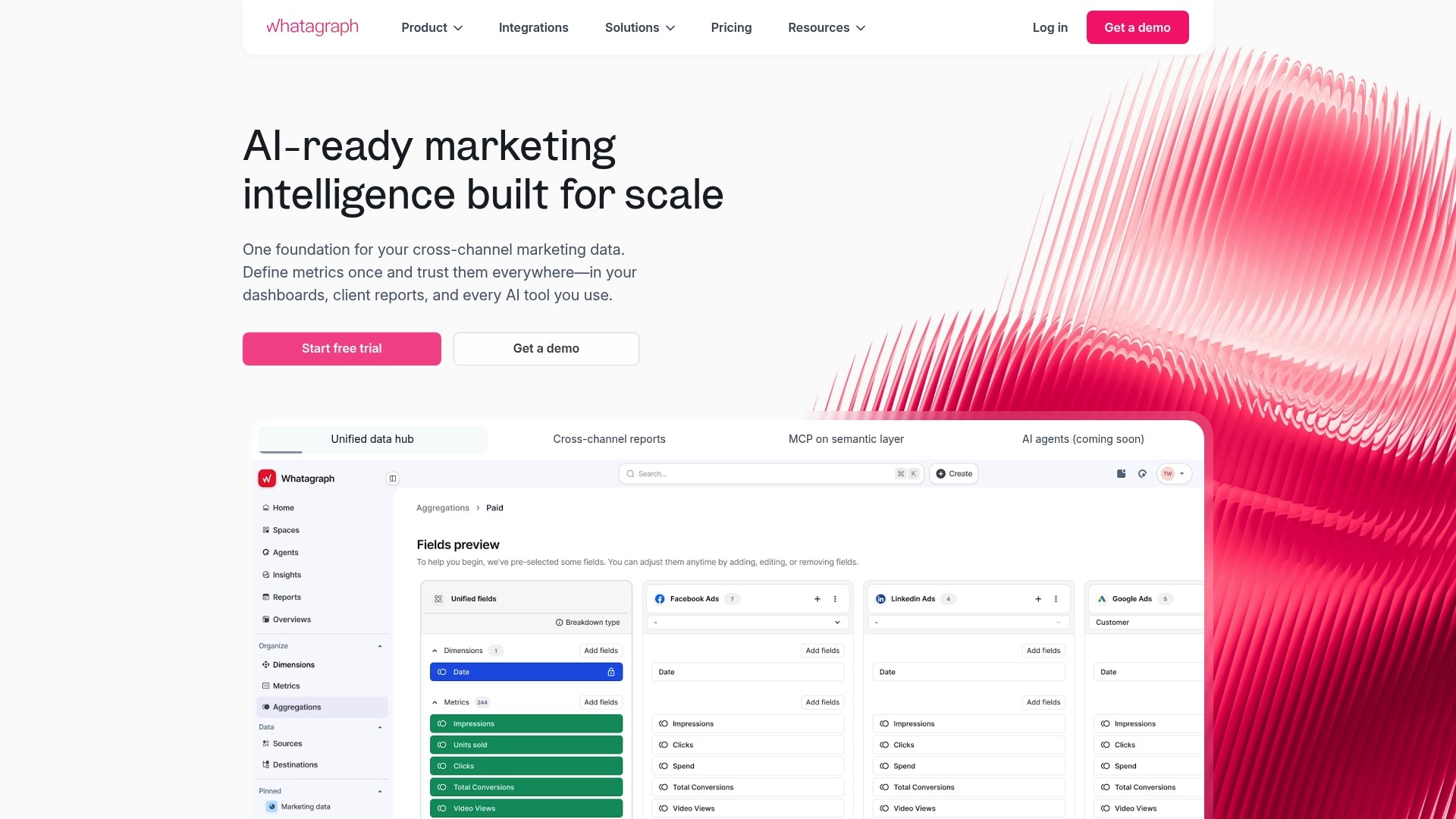
From $812 per month, billed annually, for the Max plan. Whatagraph consolidates cross-channel marketing data into a single governed hub and exposes natural language insights. Its no-code transformation tools and automated email reports make recurring client reporting less manual and faster to produce.
Core Features
Whatagraph creates a unified data hub that standardises metrics, dimensions, and source groupings for cross-channel reporting. It includes pre-built templates and AI prompts to speed report creation, plus a natural language chat for AI driven summaries. Scheduled email reports and stakeholder notifications keep teams informed of KPI changes without manual exports.
Key Differentiator
Whatagraph centralises and standardises marketing data into one governed platform while offering AI driven insight generation and no-code transformation tools. This setup suits teams that need consistent, governed reporting at scale rather than platforms primarily focused on content generation like Mycontentlab.
Pros
Whatagraph consolidates data from a wide set of sources and supports white labelling for client reports, which helps agencies present consistent branding across accounts. The platform includes AI driven analysis that removes the need for SQL or engineering support for many routine queries. Users report substantial time savings on repetitive reporting tasks, making it easier to scale without proportional headcount increases.
Cons
Some third-party reviews compare Whatagraph unfavourably with specialised BI tools and find its customisation depth and responsiveness less advanced.
Pricing and layer complexity may be excessive for small teams with only a few data sources and simple reports.
AI and automation rely on the quality of upstream data. Incomplete connections or poor transformations can reduce report accuracy.
When It May Not Fit
Teams that need deep data modelling and highly custom visualisations may prefer a specialist BI tool. Small agencies with minimal reporting needs will likely find the pricing tiers and feature set disproportionate. Organisations that cannot guarantee data completeness across sources will see limited benefit from the automation and AI features.
Notable Integrations
Whatagraph connects to Google Ads, Facebook Ads, Google Analytics 4, HubSpot, Mailchimp, Shopify, and BigQuery. It also integrates with CRM platforms such as Salesforce and HubSpot, which helps map marketing performance to sales signals.
Who It's For
Marketing teams and agencies managing multiple clients, locations, or brands at scale who need automated, repeatable reporting and governed data practices. It matches operations where consistency, white labelled delivery, and reduced manual reporting effort matter more than bespoke data modelling.
Real World Use Case
A marketing agency automates weekly client performance reports and replaces spreadsheet workflows with standardised templates. The change reduces time spent on data assembly and allows analysts to focus on interpretation, supporting longer client retention and smoother campaign reviews.
Pricing
Whatagraph lists the Max plan starting from $812 per month, billed annually, with a higher Prime plan available for custom, high volume reporting requirements. Exact costs for Prime are provided via vendor sales channels.
Website: https://whatagraph.com
Oviond
At a Glance
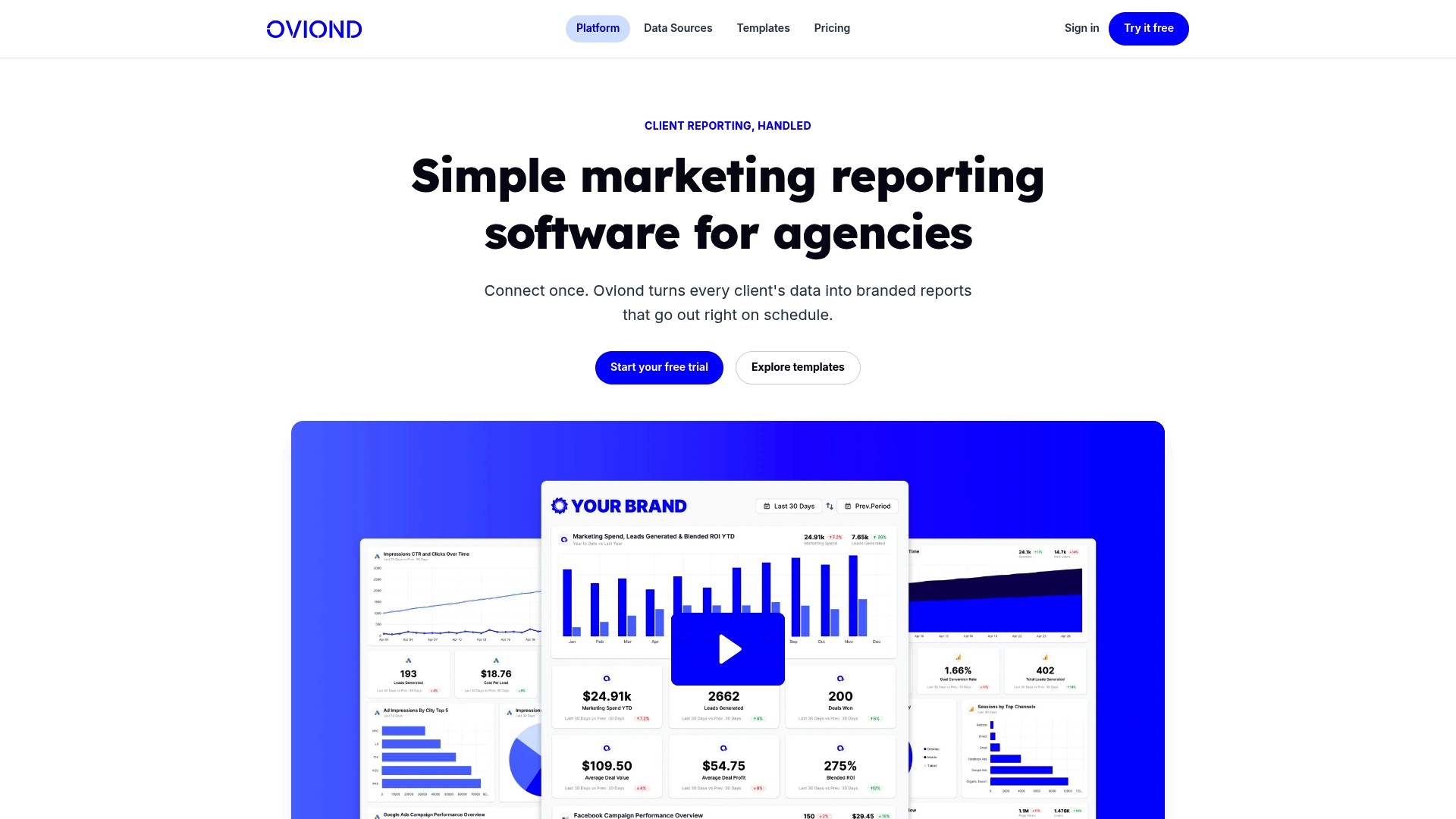
Connects more than 60 marketing data sources, covering analytics, paid media, search, social, email, CRM, and e commerce. Founded in 2018, Oviond aims squarely at agencies that need branded, scheduled reporting delivered to clients. The product also exposes AI hooks for building reports from natural language prompts.
Core Features
Oviond links many platforms into a single reporting layer and lets you build branded, customisable reports and dashboards. The interface uses a drag and drop report builder with prebuilt templates for Google Analytics, Google Ads, Facebook, and similar channels. Automated scheduling and report delivery reduce manual copying and support basic AI integrations for report generation.
Key Differentiator
The platform supports AI integration via the MCP server, which allows natural language prompts to assemble reports and surface insights. That focus on prompt driven report building separates it from tools that only offer visual dashboards. This makes Oviond a reporting first tool for agencies rather than a content generation product like Mycontentlab.
Pros
Oviond converts disparate channel metrics into clear, branded reports and reduces the time spent juggling spreadsheets and screenshots. White labelled output and custom domains help agencies keep client delivery on brand. Automation for scheduled delivery, a broad template library, and the vendor stated support for AI integrations speed up recurring reporting tasks.
Cons
Some users report occasional disconnects from data source integrations that need re authentication.
The interface can feel dull and less intuitive for first time users, according to feedback.
Mobile capability is limited because there is no dedicated mobile app.
Early minor bugs were reported by users, though many have since been fixed.
When It May Not Fit
If you require a dedicated mobile app for on the go report edits, Oviond is not ideal. Teams that expect a highly modern consumer grade interface may prefer alternatives. Organisations that cannot tolerate periodic re authentication of connectors should look elsewhere.
Notable Integrations
Google Analytics 4
Google Ads
Facebook Ads and Instagram
Google Search Console
LinkedIn Ads and Microsoft Ads
Mailchimp and email automation tools
Who It's For
Agencies and in house marketing teams that manage multiple client accounts will find Oviond relevant. It suits teams that need branded, scheduled client reports and want to reduce manual aggregation work. Small agencies seeking quick onboarding with templates also fit this product profile.
Real World Use Case
An agency connects Google Analytics, Facebook Ads, and Google Ads to a single Oviond dashboard. They apply the agency brand, schedule monthly deliveries by email, and export PDF reports for client review. Natural language prompts help assemble custom sections without rebuilding each month.
Pricing
Pricing starts at $39/month when billed annually and includes the first 5 clients. Additional clients are charged per client with lower rates as client volume increases.
Website: https://oviond.com
Swydo

At a Glance
Swydo reports it is trusted by over 2,500 companies globally. That claim highlights its focus on agencies that need repeatable, client-ready reporting. The platform offers a free 14-day trial with no credit card required and pricing that scales by data sources.
Core Features
Swydo combines automated, customisable marketing reports with a library of pre-built templates and scheduled delivery. It supports real time KPI monitoring and alerts, data blending from multiple marketing sources into single dashboards, and white label reports with branding tools and health checks for data sources. The platform also allows unlimited users and dashboards for agency teams.
Key Differentiator
Swydo pairs multi-source data blending with template-driven reports and AI-generated summaries aimed specifically at online marketing agencies. That focus makes it a narrower fit than platforms that also create content from raw data, as it centres on professional client reporting and KPI monitoring.
Pros
Swydo reports users save up to 8–16 hours per week by automating recurring reports, which frees time for strategy and client meetings. Its high level of customisation and scheduled report delivery make handling multiple clients more efficient, and the visual interface reduces the effort needed to explain metrics. Strong onboarding and responsive support shorten setup time and help troubleshoot integration issues quickly.
Cons
Advanced customisation has a learning curve for teams new to report templates. Some users need training to use complex layouts.
Pricing can rise sharply for agencies with a very high number of data sources. Costs scale with connected sources.
The product focuses on marketing data only, so it will not replace general business intelligence tools for non-marketing reporting.
When It May Not Fit
Organisations that need to combine marketing and non-marketing datasets will find Swydo limiting. Agencies with dozens of sources per client should model costs first, since the vendor states pricing scales by data sources. Small teams wanting simple ad hoc analysis rather than scheduled client reports may prefer a simpler dashboard tool.
Notable Integrations
Google Ads
Facebook Ads
Google Analytics 4
Google Sheets
LinkedIn Ads
TikTok Ads
X (Twitter) Ads
YouTube
Who It's For
Digital marketing agencies and professionals managing multiple client accounts will gain most from Swydo. The platform suits teams that must produce branded monthly reports, monitor KPIs across channels, and maintain scheduled deliveries without involving developers.
Real World Use Case
An SEO agency uses Swydo to build branded monthly reports that pull from Google Analytics, Google Ads, and Facebook Ads. The team sets KPI alerts for traffic drops and delivers scheduled PDFs to clients, reducing manual data pulls and revision cycles.
Pricing
The published starter price is $62 monthly when billed annually, with costs that scale depending on the number of data sources. A 14-day free trial is available with no credit card required.
Website: https://swy.do
Comparison of alternatives
Consolidating operational needs into a marketing reporting solution often requires choosing between diverse features. Here, key competitors to Mycontentlab.ai are compared, evaluating their unique strengths and targeted use cases.
Integration capabilities
AgencyAnalytics offers the most connectivity, boasting 85+ supported platforms. This feature is instrumental for agencies aiming to centralise reporting across multiple data inputs. In contrast, Mycontentlab directly incorporates ideation and performance analysis into a unified interface, which simplifies creative workflows but might require supplemental tools for niche integrations. The choice depends on the specific data ecosystem managed by the team.
Suitability for large-scale operations
When aligning tools to substantial operational needs, Whatagraph stands out by providing centralised, repeatable reporting processes suited for large organisations managing extensive data sources. Its approach to governance and no-code transformation enhances data reliability and usability. Where this level of infrastructure is unnecessary, Mycontentlab offers streamlined ideation for moderately-sized teams focusing on immediate content tasks.
Best fit
Teams needing a unified workspace linking performance data to ideation will appreciate Mycontentlab.ai for its straightforward approach.
Agencies managing multiple clients and requiring high integration capability will benefit from the extensive compatibility of AgencyAnalytics.
Organisations at scale requiring governance and automated reporting will find their needs met with Whatagraph’s no-code solution.
Our pick
Mycontentlab.ai uniquely facilitates creative output by directly linking derived metrics to ideation processes, efficiently turning insights into content. For teams prioritising both insightful analysis and creative generation within one platform, this solution offers efficiency and cohesion.
Which platform integrates trend analysis, reporting, and ideation seamlessly?
Platform | Key Differentiator | Primary Users | Pricing | Notable Limitation |
|---|---|---|---|---|
Mycontentlab | Unified workspace for ideation and analytics | Agencies and content creators | £47–£497 monthly | Limited third-party integrations available |
AgencyAnalytics | Extensive integrations with AI-driven insights | Marketing agencies | $20 USD per client monthly | Moderate onboarding learning curve |
Whatagraph | Standardised reporting with AI insights | Large-scale marketing teams | Starting at $812 monthly | Customisation depth compared to BI tools |
Oviond | Natural language report assembly | Agencies managing multiple clients | Starting at $39/month | Periodic re-authentication of integrations |
Swydo | Customised multi-source report generation | Digital marketing agencies | Starting at $62 monthly | Advanced customisation learning curve |
How Can Marketing Teams Simplify Reporting and Content Creation?
Marketing analytics platforms often overwhelm agencies, freelancers, and in-house teams with scattered data and time-consuming manual reporting. A common challenge is converting raw performance metrics into clear reports and fresh content ideas without flipping between tools. Mycontentlab offers a unique workspace where data and creative prompts live side by side. It helps users generate client-ready reports and content hooks from actual channel performance, reducing tedious report assembly.
With Mycontentlab, you get:
AI-powered insights that link directly to source metrics
Faster client reporting and briefing workflows
Support tailored for agencies, freelancers, and in-house teams
Learn more about Mycontentlab and see how to improve productivity by turning your marketing metrics into compelling client materials quickly.
FAQ
Which platform provides the best integration for data automation?
Mycontentlab stands out for its seamless linking of analytics and content ideation. The platform connects performance metrics directly to content strategies, making it easier for teams to generate ideas from real data. Consider using Mycontentlab if you need a comprehensive view from a single workspace.
How does Mycontentlab compare with AgencyAnalytics in terms of client reporting?
AgencyAnalytics excels in providing automated client reporting along with white label options, allowing agencies to deliver branded reports effortlessly. Mycontentlab, while also offering performance-based content ideas, focuses more on content generation than traditional reporting functionalities. Use Mycontentlab if your priority is to convert metrics directly into content ideas.
What are the pricing tiers for Mycontentlab?
Mycontentlab offers pricing that starts at £47 per month and scales to £497 per month, catering to both freelancers and larger teams. This tiered pricing structure allows teams to choose a plan that aligns with their specific needs and budget. Evaluate which tier fits your requirements to maximise value.
Does Mycontentlab support multiple marketing channels for performance tracking?
Yes, Mycontentlab supports multiple channels, including Google, YouTube, TikTok, and Reddit, within its integrated framework. This allows for broader analysis and content ideation based on diverse metrics from various platforms. Plan to utilise Mycontentlab for comprehensive coverage of your marketing efforts.
Can I generate content ideas based on real-time performance metrics using Mycontentlab?
Mycontentlab can generate content ideas from actual channel data, linking performance metrics to creative outputs. This functionality helps streamline the content creation process by providing actionable insights directly from performance analytics. Leverage this feature to improve your content strategies based on real-time data.
Recommended


Jul 19, 2026


Search



You can also read
Category
All
Compare
Marketing Reporting
Agency Operations
Content Intelligence
Brand Monitoring
Platform Reporting