Best marketing agency tools for UK agencies in 2026
Discover the best marketing agency tools for UK agencies in 2026. Boost productivity and streamline projects with top-rated solutions!

TL;DR:
UK agencies in 2026 should prioritize integrated, AI-driven tools that automate workflows and share data seamlessly. Building a small core stack of three to five multifunctional systems, connected by automation layers, maximizes output and reduces manual work. AI-based reporting tools like Mycontentlab can cut non-billable hours significantly by transforming raw data into client-ready insights.
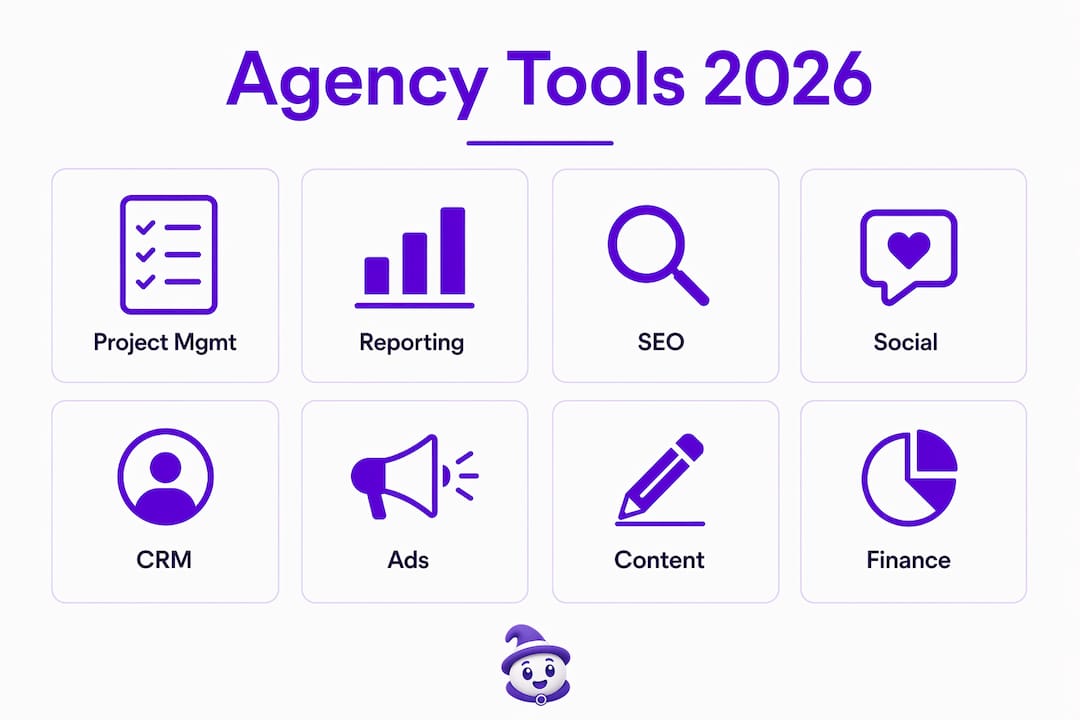
The strongest marketing agency tools for UK agencies in 2026 are Semrush, HubSpot, Productive, AgencyAnalytics, and Asana, each covering a distinct operational need. Agencies that build integrated stacks rather than accumulate disconnected apps consistently outperform those that do not, producing significantly more output per team member without proportionally increasing headcount. The tools below are available across the UK market, carry GDPR-relevant data controls, and address the four core agency needs: project delivery, client reporting, paid and organic acquisition, and creative production.
The shortlist at a glance:
Project and operations management: Productive, Scoro, Teamwork.com, Asana, monday.com, Wrike, Notion, Hive, Kantata, Synergist, Paprika, Nutcache, Bonsai Agency Software
CRM and marketing automation: HubSpot, Pipedrive, Snov.io
Reporting and analytics: AgencyAnalytics, Funnel, Google Looker Studio, Google Analytics 4, Supermetrics, Ruler Analytics, Fospha, Mycontentlab
SEO: Semrush, Ahrefs, SE Ranking, Screaming Frog, Surfer SEO, Clearscope, BuzzSumo, Google Search Console, AccuRanker, Surfer AI, Semrush AI Visibility Toolkit, AtomicAGI, Birdeye Search AI, Google Trends
Social media management: Hootsuite, Sprout Social, Agorapulse, Buffer, Later Social, Sendible, Zoho Social, Sprinklr, Statusbrew, Famewall
Paid advertising: Google Ads, Google Ads Editor, Meta Ads, LinkedIn Ads, Microsoft Advertising, Amazon Advertising, Optmyzr, Wordstream, AdRoll, Unbounce, CallRail, CallTrackingMetrics
Content and creative: Writesonic, Jasper AI, Invideo, Lumen5, Synthesia, Figma, Adobe Express, Admaker by Picsart, Visme, Framer, Lovable
Analytics infrastructure: Similarweb, Wappalyzer, Stape Setup Assistant, Website Tracking Checker
Financial management: Sage Intacct
Email marketing: Mailchimp, Mailerlite
How do the leading marketing agency tools compare in 2026?
Choosing between 77 tools is genuinely hard. The table below maps each tool to its primary use case, key differentiator, and pricing model so you can shortlist quickly. All tools listed are available to UK agencies.
Tool | Best for | Key differentiator | Pricing model | UK availability |
|---|---|---|---|---|
Resource and profitability tracking | Financial analytics tied to project budgets | Tiered subscription | ✓ | |
Custom workflow automation | Visual timelines, 200+ integrations | Tiered per seat | ✓ | |
Real-time team collaboration | Workload balancing and reporting | Tiered per seat | ✓ | |
Funnel | Multi-source data aggregation | Automated marketing data pipelines | Usage-based tiers | ✓ |
Free custom dashboards | Blends Google and third-party data | Free | ✓ | |
Cross-platform audience insights | Event-based tracking model | Free / paid | ✓ | |
Complex project timelines | Automation rules and workflow builder | Freemium + tiers | ✓ | |
Knowledge and lightweight project tracking | Flexible databases and wikis | Freemium + tiers | ✓ | |
CRM and inbound automation | Unified marketing, sales, and service hubs | Freemium + tiers | ✓ | |
AI marketing copy at scale | Dual AI engine for varied content styles | Tiered subscription | ✓ | |
Social and promotional video creation | Template-driven video builder | Freemium + tiers | ✓ | |
Paprika | Project and financial management | Integrated billing and resource planning | Tiered subscription | ✓ |
Complex job costing | Detailed profitability analytics | Tiered subscription | ✓ | |
End-to-end agency operations | Custom workflows and dashboards | Tiered per seat | ✓ | |
Contracts and invoicing | Fast setup and client collaboration | Tiered subscription | ✓ | |
Large-agency resource planning | Multi-dimensional resource scheduling | Enterprise pricing | ✓ | |
Creative team collaboration | Email integrations and action cards | Tiered per seat | ✓ | |
Client-facing project collaboration | Unlimited client access and billing | Tiered per seat | ✓ | |
Unified tracking and billing | Time tracking linked to invoices | Tiered subscription | ✓ | |
Visual sales pipeline | Simple CRM with automation | Tiered per seat | ✓ | |
Email campaigns and automation | Rich templates, wide integrations | Freemium + tiers | ✓ | |
Real-time design collaboration | Cloud-based with version control | Freemium + tiers | ✓ | |
Fast social asset creation | Extensive template library | Freemium + tiers | ✓ | |
Rapid ad creative generation | AI-driven design variations | Tiered subscription | ✓ | |
Ruler Analytics | Revenue attribution | Multi-touch attribution models | Tiered subscription | ✓ |
Predictive ROI analytics | Data science-driven attribution | Enterprise pricing | ✓ | |
Cost-effective email marketing | Simple automation workflows | Freemium + tiers | ✓ | |
Social listening and metrics | Custom dashboards and alerts | Tiered subscription | ✓ | |
AgencyAnalytics | Automated client reporting | 80+ integrations for multi-tool reporting | Tiered per client | ✓ |
Multi-account social management | Scheduling and monitoring at scale | Tiered subscription | ✓ | |
Data-driven content optimisation | Real-time SERP analysis | Tiered subscription | ✓ | |
Advanced agency accounting | Compliance and audit features | Tiered subscription | ✓ | |
Social publishing and engagement | Detailed social reporting | Tiered per seat | ✓ | |
Visual social content planning | Intuitive calendar interface | Tiered subscription | ✓ | |
Engagement and campaign management | Social inbox and CRM integration | Tiered per seat | ✓ | |
Simplified social scheduling | Affordable and easy to use | Freemium + tiers | ✓ | |
Multi-channel social publishing | Wide social network integrations | Tiered subscription | ✓ | |
Affordable social monitoring | Good CRM integration | Tiered subscription | ✓ | |
Enterprise social operations | Omnichannel digital management | Enterprise pricing | ✓ | |
Team social publishing workflows | Approval workflows and reporting | Tiered per seat | ✓ | |
Competitive SEO research | Huge backlink index | Tiered subscription | ✓ | |
End-to-end SEO and competitor analysis | Extensive toolset with AI features | Tiered subscription | ✓ | |
Affordable SEO monitoring | User-friendly interface | Tiered subscription | ✓ | |
Technical SEO audits | Deep crawl insights | Free + paid licence | ✓ | |
SEO content briefs | Integration with writing platforms | Tiered subscription | ✓ | |
Content research and trend analysis | Viral content detection | Tiered subscription | ✓ | |
Search traffic monitoring | Direct Google data | Free | ✓ | |
Fast keyword rank tracking | Daily rank updates | Tiered subscription | ✓ | |
Semrush AI Visibility Toolkit | AI-enhanced SEO visibility | Automated insights and recommendations | Included in Semrush | ✓ |
AI marketing automation at scale | Advanced campaign orchestration | Tiered subscription | ✓ | |
Customer feedback analytics | NLP-driven sentiment insights | Tiered subscription | ✓ | |
Market and keyword trend research | Real-time trending data | Free | ✓ | |
Paid search and display campaigns | Extensive reach and targeting | Pay-per-click | ✓ | |
Google Ads Editor | Bulk offline campaign management | Efficient large account management | Free | ✓ |
PPC automation and optimisation | Automation and reporting features | Tiered subscription | ✓ | |
Cross-platform paid campaign management | Simplified PPC management | Tiered subscription | ✓ | |
Conversion-optimised landing pages | Drag-and-drop builder with A/B testing | Tiered subscription | ✓ | |
Paid search on Microsoft network | Bing and Yahoo integration | Pay-per-click | ✓ | |
Ecommerce advertising on Amazon | Targeted product promotion | Pay-per-click | ✓ | |
Meta Ads | Social paid campaigns | Vast audience targeting options | Pay-per-click | ✓ |
LinkedIn Ads | B2B lead generation | Precision targeting by job and company | Pay-per-click | ✓ |
CallRail | Call attribution and analytics | Multi-channel call attribution | Tiered subscription | ✓ |
Offline marketing call tracking | Conversion tracking | Tiered subscription | ✓ | |
Retargeting and prospecting | Cross-channel retargeting | Tiered subscription | ✓ | |
Website Tracking Checker | Analytics tagging audits | Identifies tracking errors quickly | Free / paid | ✓ |
Competitor traffic analysis | Broad digital market intelligence | Tiered subscription | ✓ | |
Tech stack research | Browser extension and reports | Freemium + tiers | ✓ | |
GA4 and GTM implementation | Step-by-step setup guidance | Tiered subscription | ✓ | |
Supermetrics | Reporting data integration | Connects multiple data sources to BI tools | Tiered subscription | ✓ |
Reports and marketing materials | Templates and drag-and-drop design | Freemium + tiers | ✓ | |
Interactive website prototyping | Real-time collaboration | Freemium + tiers | ✓ | |
Email prospecting and outreach | Lead finder and email verifier | Tiered subscription | ✓ | |
Diverse marketing content generation | Supports multiple languages and tones | Tiered subscription | ✓ | |
Surfer AI | AI-driven SEO content | Real-time content scoring | Included in Surfer SEO | ✓ |
Text-to-video content creation | Simple AI video builder | Freemium + tiers | ✓ | |
Personalised AI avatar video | Text-to-video at scale | Tiered subscription | ✓ | |
Customer engagement analytics | Behavioural insights and segmentation | Tiered subscription | ✓ | |
AI-powered reporting and content intelligence | Converts live performance data into client-ready reports and content ideas | Tiered subscription | ✓ |
Project and operations management tools
Productive is the strongest choice for agencies that need to see profitability at the project level, not just at the end of the month. Its financial analytics sit directly alongside resource scheduling, so account managers can spot a budget overrun before it becomes a client conversation. Scoro takes a similar approach but leans more heavily on customisable dashboards and end-to-end workflow management, making it well suited to agencies running complex, multi-service retainers.

Teamwork.com stands out for client-facing work. Unlimited client access means you can invite clients into projects without paying extra per seat, which changes the economics for agencies managing many accounts simultaneously. Kantata targets larger agencies with multi-dimensional resource scheduling that handles capacity planning across departments, though its enterprise pricing reflects that scope.
For smaller or growing agencies, Asana and monday.com offer the most accessible entry points. Asana's automation rules reduce repetitive task creation, while monday.com's visual timelines and 200+ app integrations suit teams that want to build their own workflow logic without writing code. Notion works best as a knowledge base and lightweight tracker rather than a full project management system; it excels when paired with a dedicated delivery tool.
Hive, Wrike, Nutcache, Bonsai Agency Software, Synergist, and Paprika each fill specific gaps. Wrike handles real-time workload balancing well. Nutcache links time tracking directly to invoices, which removes a manual step that most agencies quietly waste hours on each month. Synergist and Paprika are both built specifically for UK agencies, with Synergist carrying particularly detailed job costing features.
Reporting, analytics, and attribution tools
AgencyAnalytics is the go-to for automated client reporting, pulling data from more than 80 integrations into white-labelled dashboards. It removes the weekly ritual of copying figures between platforms. Funnel takes a different angle: it focuses on aggregating raw marketing data from multiple paid and organic sources into a clean, analysis-ready layer, which then feeds into Google Looker Studio or a BI tool of your choice.
Google Looker Studio remains the most cost-effective reporting front-end available. It is free, connects to Google Analytics 4, Google Ads, and dozens of third-party connectors, and produces genuinely polished dashboards. Google Analytics 4 itself has become the baseline for any agency managing website performance, with its event-based model enabling cross-platform user journey analysis that Universal Analytics could not replicate.
Supermetrics sits between the data sources and the reporting layer, pulling metrics from paid, social, and SEO platforms into Google Sheets, Looker Studio, or Power BI. Ruler Analytics and Fospha address the attribution gap that most reporting tools leave open: connecting individual marketing touchpoints to actual revenue. Ruler Analytics uses multi-touch attribution models, while Fospha applies data science to predict ROI across channels.
Mycontentlab occupies a distinct position in this category. Rather than simply aggregating data, it uses AI to convert live performance metrics into client-ready reports and content ideas, connecting more than 20 analytics, paid, and social platforms. For agencies that spend hours each week writing commentary around their data, that distinction matters in practice.
SEO tools for agencies
Semrush and Ahrefs are the two tools most UK agencies reach for first, and for good reason. Semrush covers keyword research, site audits, competitor gap analysis, and position tracking in one subscription, with the Semrush AI Visibility Toolkit adding automated recommendations on top. Ahrefs carries the largest backlink index available and remains the preferred choice for link-building campaigns and competitive research.
SE Ranking offers a more affordable entry point without sacrificing the core features: rank tracking, site audits, and keyword research are all present and well executed. Screaming Frog is the standard for technical SEO audits; its desktop crawler surfaces crawl errors, redirect chains, and duplicate content issues that browser-based tools miss. Google Search Console provides the most authoritative data on how Google actually sees your site, and it is free.
AccuRanker delivers daily rank updates faster than most platforms, which matters when you are managing time-sensitive campaigns. Surfer SEO and Surfer AI focus on content optimisation, scoring pages against live SERP data so writers know exactly what to adjust. Clearscope takes a similar approach with tighter integration into Google Docs and Word. BuzzSumo identifies trending content and key influencers, useful for content strategy and digital PR. AtomicAGI and Birdeye Search AI bring AI-driven automation and sentiment analysis respectively, while Google Trends remains the quickest way to validate whether a topic has genuine search momentum.
Social media management tools
Hootsuite and Sprout Social handle the most demanding multi-account environments, with Sprout Social's reporting depth making it the stronger choice when clients expect detailed engagement analytics. Agorapulse adds a social inbox and CRM layer that keeps client conversations organised alongside publishing. Buffer and Later Social suit smaller teams or agencies managing fewer accounts; both are genuinely easy to use and affordable.
Sendible, Zoho Social, and Statusbrew each cover multi-channel publishing with varying degrees of workflow sophistication. Statusbrew's approval workflows are particularly useful for agencies that need sign-off processes before posts go live. Sprinklr is built for enterprise-scale social operations and carries a price tag to match. Famewall handles social listening and custom performance dashboards for agencies tracking brand mentions across channels.
Paid advertising and conversion tools
Google Ads and Google Ads Editor are the foundation of any paid search operation. The Editor's offline bulk editing capability saves hours when managing large accounts with hundreds of campaigns. Optmyzr and Wordstream layer automation and optimisation on top of Google Ads, reducing the manual work of bid adjustments and quality score improvements. Microsoft Advertising extends reach across Bing and Yahoo, often at lower cost-per-click than Google for certain B2B audiences.
Meta Ads and LinkedIn Ads cover the two dominant social paid channels. LinkedIn Ads' precision targeting by job title, company size, and industry makes it the default for B2B lead generation campaigns. Amazon Advertising is relevant for agencies with ecommerce clients. AdRoll handles retargeting across channels, while Unbounce builds the conversion-optimised landing pages that paid campaigns need to perform.
CallRail and CallTrackingMetrics close the attribution loop for agencies running campaigns that drive phone enquiries. Ruler Analytics, mentioned above in the reporting section, connects those calls back to the original marketing source. Website Tracking Checker, Wappalyzer, and Stape Setup Assistant are the infrastructure tools that keep analytics tagging accurate and GA4 implementations clean.
Content creation and creative tools
Writesonic and Jasper AI are the two most widely used AI writing tools in UK agencies. Writesonic's dual AI engine produces varied output styles, useful when you need both long-form articles and short ad copy from the same platform. Jasper AI supports multiple languages and tones, which matters for agencies with international clients.
For video, Invideo and Lumen5 handle the conversion of text or existing content into social-ready video quickly. Synthesia goes further, generating AI avatar videos from a script, which agencies use for training content, product explainers, and personalised outreach at scale. Figma is the standard for design collaboration, with real-time co-editing and version control that keeps creative teams and clients aligned. Adobe Express and Admaker by Picsart cover faster, template-driven asset creation for social and display. Visme handles reports and presentation materials. Framer is the tool of choice for agencies building interactive website prototypes or publishing directly to the web.
CRM, sales, and email tools
HubSpot remains the most complete CRM and marketing automation platform available to UK agencies, with its marketing, sales, and service hubs sharing a single contact database. Pipedrive is the leaner alternative for agencies focused primarily on deal tracking rather than full inbound automation. Snov.io handles email prospecting and lead verification, useful for new business development teams.
Mailchimp is the most widely used email platform globally, with a template library and integration ecosystem that suits agencies managing campaigns for multiple clients. Mailerlite is the cost-effective alternative for smaller agencies or those managing lower-volume lists. Both support automation workflows, though Mailchimp's is more extensive.
Financial management
Sage Intacct handles advanced accounting and financial reporting for agencies that have outgrown standard bookkeeping tools. Its compliance and audit features are particularly relevant for UK agencies operating under FRS 102 or managing multi-entity structures. For agencies that want financial management built into their project tool rather than as a separate system, Productive and Scoro both carry billing and budget tracking natively.
How to choose the right tools for your UK agency
The single most common mistake agencies make is selecting the best individual tool in each category without thinking about how those tools will share data. Choosing a connected stack where tools pass information automatically is more valuable than picking the highest-rated option in each category in isolation. A project management tool that does not connect to your time-tracking or billing system creates a manual handoff that someone has to perform every week.
Core evaluation criteria
Functionality fit comes first. Generic task boards do not track billable hours, retainer profitability, or client approval workflows, which are the specific features agency software must cover. Before evaluating any tool, list the agency-specific workflows it needs to support.
Integration capability is the second filter. Check whether the tool connects natively to the rest of your stack, or whether you will need an orchestration layer like Zapier, Make, or n8n to bridge the gap. Native integrations are faster to set up; orchestration platforms give you more control over complex, multi-step logic.
Scalability matters more than it appears at the shortlisting stage. A tool that works for a five-person team may hit limits at twenty. Check seat pricing, client workspace limits, and API access before committing.
Cost of ownership goes beyond the monthly subscription. Factor in onboarding time, training, and the cost of any integrations or add-ons. A typical 10-person UK agency stack costs $400–600 per month across multiple tools, and coordination overhead between those tools adds further hidden cost.
UK compliance is non-negotiable. Any tool handling client data must support UK GDPR requirements, including data residency options and data processing agreements. Tools with EU or UK data centres are preferable for agencies managing sensitive client data.
Questions to ask software vendors
Where is client data stored, and does the tool offer a UK or EU data residency option?
What is the maximum number of client workspaces or projects on each pricing tier?
Does the tool provide a dedicated onboarding process, and what does ongoing support look like?
Which native integrations are included, and which require a third-party connector?
How does the tool handle user permissions for client access?
Is there an API, and what rate limits apply?
What is the contract length, and are there exit clauses?
Pro Tip: Before signing any annual contract, run a 30-day pilot with your two most complex client accounts. If the tool cannot handle your messiest workflows in a controlled test, it will not handle them under real pressure.
Building a connected stack rather than accumulating tools
Tool bloatis the default state for most agencies. Teams add a new tool to solve a specific problem, and six months later they are paying for five platforms that do not talk to each other. The practical fix is to audit your current stack against three questions: does this tool do something another tool already does, does it require manual data entry to stay current, and would removing it break anything? Tools that fail the first two tests are candidates for consolidation.
Optimal agency stacks tend to contain three to five multifunctional tools that cover multiple workflows natively, rather than ten single-purpose apps connected by fragile integrations. Productive, Scoro, and Teamwork.com each cover project management, time tracking, and billing in one system. HubSpot covers CRM, email marketing, and basic reporting. AgencyAnalytics or Mycontentlab covers client reporting. That is a functional four-tool core that most mid-size UK agencies can build on.
How to build and optimise your agency tech stack in 2026
UK agencies with integrated, AI-optimised stacks produce roughly three times the output per team member compared to those running traditional, disconnected workflows. That gap is not primarily about the tools themselves. It is about whether those tools share data automatically or require a person to move information between them.
The orchestration layer
The decisive component in any high-performing stack is the orchestration layer. Zapier, Make, and n8n sit between your tools and automate multi-step workflows that would otherwise require manual intervention. For UK agencies starting out with automation, Zapier offers the easiest entry point, with a no-code interface and thousands of pre-built connections. Make and n8n provide greater logic and control for complex workflows, including conditional branching and data transformation, which matters for agencies with compliance requirements around how client data is processed.
A practical example: when a new project is created in Asana, an orchestration workflow can automatically create a corresponding client folder in Google Drive, add the project to a Teamwork.com billing tracker, and send a Slack notification to the account manager, without anyone touching a keyboard. That kind of automation removes the coordination tax that accumulates across dozens of small handoffs each week.
Phased rollout strategy
Attempting to migrate an entire agency onto a new stack in one go almost always fails. A phased approach works better.
Phase 1 (weeks 1–4): Implement the project management and time-tracking core. Get the team logging hours accurately before adding complexity.
Phase 2 (weeks 5–8): Connect reporting. Integrate your analytics and paid platforms into a single reporting layer, whether that is AgencyAnalytics, Funnel, or Mycontentlab.
Phase 3 (weeks 9–12): Add orchestration. Once the core tools are stable, build the automation workflows that connect them.
Phase 4 (ongoing): Audit and consolidate. Remove tools that have been replaced by the new stack's native capabilities.
Statistic callout: Automated multi-platform reporting dashboards save mid-size agencies approximately 100 hours a month previously spent on manual reporting. At a conservative blended rate, that represents a meaningful reduction in non-billable time each month.
Key optimisation tactics
Consolidate project management and billing into one platform rather than running separate tools for each.
Use a single source of truth for client data: one CRM that all other tools reference, rather than contact lists scattered across email, spreadsheets, and project tools.
Automate recurring reports. Any report produced on the same schedule with the same data sources should be automated; manual reporting is the single largest source of recoverable non-billable hours in most agencies.
Standardise onboarding. Build a template project in your project management tool that covers every standard deliverable for each service line, so new client setups take minutes rather than hours.
Review the stack quarterly. Tools change, pricing changes, and agency needs evolve. A quarterly audit prevents the gradual accumulation of redundant subscriptions.
Pro Tip: When evaluating whether to add a new tool, ask whether it reduces a manual step or adds a new one. A tool that creates data you then have to move somewhere else manually is a net negative, regardless of its individual feature set.
Mycontentlab turns your data into client-ready reports and content ideas
Most agencies already have the data. The problem is the hours spent turning it into something a client can read and act on. Mycontentlab addresses that specific gap: it connects more than 20 analytics, paid, and social platforms and uses AI to convert raw performance metrics into polished, client-ready reports and content ideas automatically.
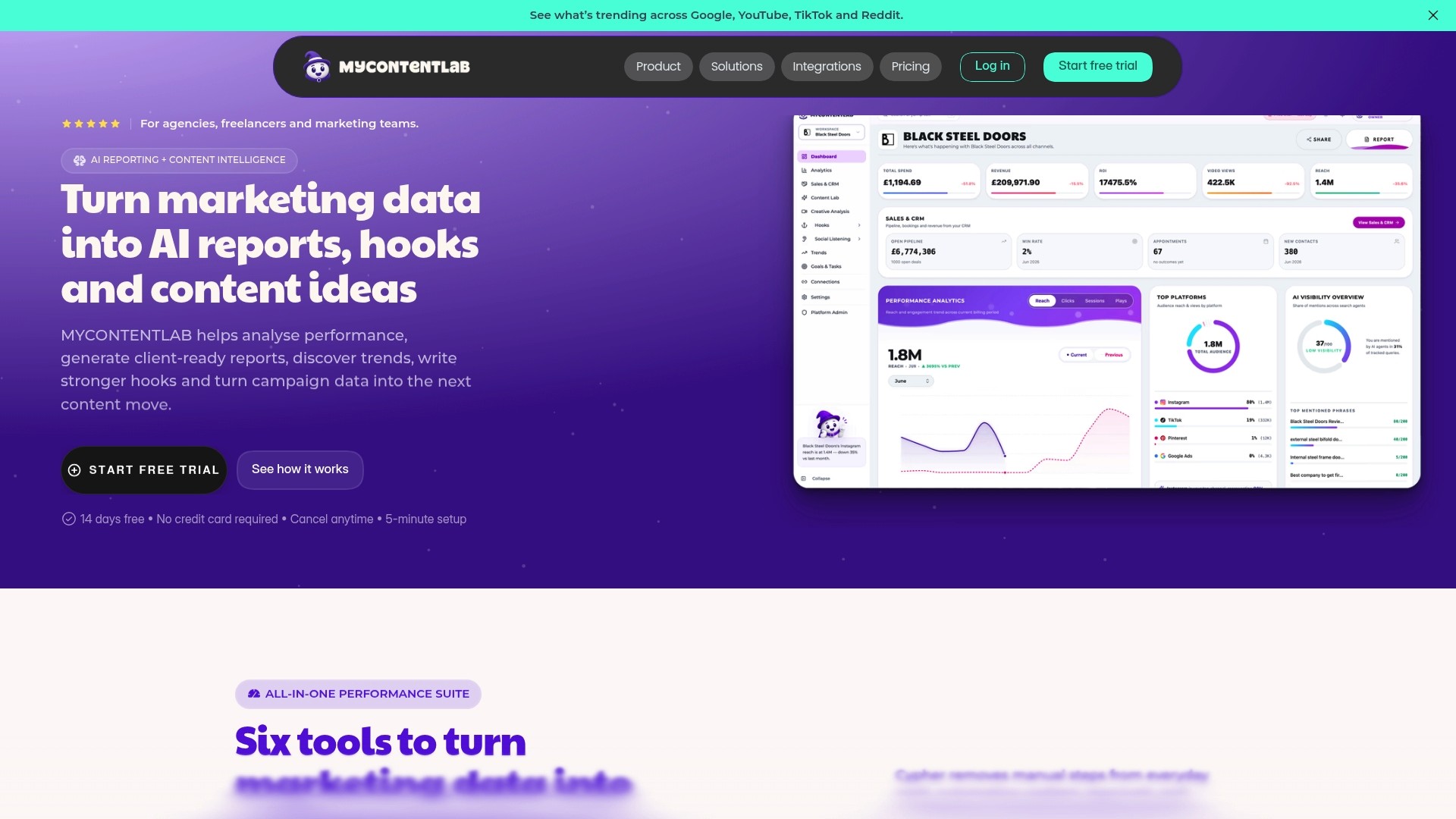
Where AgencyAnalytics and Supermetrics focus on aggregating and visualising data, Mycontentlab goes a step further by generating content hooks, campaign recommendations, and trend analysis directly from your live metrics. For agencies that want to reduce non-billable reporting time while simultaneously improving the quality of client communication, that combination is worth considering alongside the tools compared above. Tiered plans cover individual freelancers through to multi-client agency workspaces, with white-labelling available on higher tiers. You can explore the agency reporting features or see how the analytics module connects your existing data sources.
FAQ
What tools do marketing agencies typically use?
Most UK agencies run a core stack covering project management (Asana, monday.com, or Productive), CRM (HubSpot or Pipedrive), SEO (Semrush or Ahrefs), social media management (Hootsuite or Sprout Social), and reporting (AgencyAnalytics or Google Looker Studio), supplemented by paid advertising platforms and content creation tools.
What are agency management tools?
Agency management tools are software platforms built specifically for agency operations, covering retainer management, client approval workflows, billable hour tracking, and project profitability, features that generic project management tools do not include. Productive, Scoro, Synergist, and Teamwork.com are leading examples available to UK agencies.
How many tools should a marketing agency use?
Optimal agency stacks contain three to five multifunctional tools rather than ten or more single-purpose apps. Keeping the stack tight reduces integration complexity, training overhead, and the coordination costs that accumulate when data has to move manually between disconnected platforms.
Which tool is best for automated client reporting?
AgencyAnalytics is the most widely used dedicated client reporting platform, with more than 80 integrations and white-labelled dashboards. Mycontentlab is the stronger choice for agencies that want AI-generated commentary, content ideas, and recommendations built directly into their reports alongside the data.
How do UK GDPR requirements affect tool selection?
Any tool handling client or end-user data must provide a data processing agreement, support data subject access requests, and ideally offer UK or EU data residency. Tools like HubSpot, Semrush, and Asana all publish GDPR compliance documentation; verify data storage location and DPA terms before signing any contract involving personal data.
Key takeaways
The most effective agency stacks in 2026 are built around three to five integrated tools connected by an orchestration layer, not around selecting the highest-rated option in every category.
Point | Details |
|---|---|
Integration beats individual tool quality | A connected stack where tools share data automatically outperforms a collection of best-in-class tools that require manual handoffs. |
Agency-specific features matter | Generic project tools lack retainer management, client approval workflows, and profitability tracking; choose platforms built for agency operations. |
Stack costs add up quickly | A typical 10-person UK agency stack costs $400–600 per month across multiple tools, making consolidation a financial as well as operational priority. |
Automation recovers billable time | Automated reporting dashboards save mid-size agencies approximately 100 hours a month previously spent on manual reporting. |
Mycontentlab for reporting and content intelligence | Mycontentlab converts live performance data from 20+ platforms into client-ready reports and content ideas, reducing non-billable reporting time for UK agencies. |
Recommended

Jul 19, 2026


Search



You can also read
Category
All
Compare
Marketing Reporting
Agency Operations
Content Intelligence
Brand Monitoring
Platform Reporting