Best SEO reporting software for clients in 2026
Discover the best SEO reporting software for clients in 2026. Compare top tools and automate your reporting for better insights!

Which SEO reporting tools are worth your agency's time in 2026?
The strongest SEO reporting software for clients in 2026 does three things well: it pulls data automatically, presents it in a format your client can actually understand, and saves your team from spending half a Tuesday reformatting spreadsheets. AgencyAnalytics, DashThis, and Whatagraph lead the field for most UK agencies, but the right choice depends heavily on your team size, client mix, and whether white-labelling is a dealbreaker.
The market has shifted. AI visibility metrics now sit alongside traditional KPIs in client-facing reports, covering branded query volume, AI citation rates, and referrals from tools like ChatGPT and Perplexity. Agencies that ignore this shift are already handing their competitors a talking point. The platforms reviewed here are all available to UK agencies, with pricing in USD unless otherwise noted.
Tool | Best for | Key features | Automation | White-label | Starting price |
|---|---|---|---|---|---|
DashThis | Automated agency reporting | Drag-and-drop dashboards, 34+ integrations | Scheduled reports | Yes | — |
AgencyAnalytics | Large agencies, 80+ integrations | Client dashboards, rank tracking, custom reports | Full automation | Yes | $12/mo per campaign |
Whatagraph | Visual, automated reporting | Cross-channel dashboards, scheduled delivery | High | Yes | — |
Small to mid-sized agencies | Rank tracking, site audit, AI overview monitoring | Moderate | Yes | — | |
Semrush | Full-suite SEO with reporting | Keyword, backlink, site audit, AI tracking | High | Partial | — |
Backlink-focused reporting | Backlink index, rank tracker, content explorer | Moderate | No | — | |
Brand-familiar rank tracking | DA metrics, rank tracker, site crawl | Moderate | No | — | |
Databox | Flexible dashboard customisation | 100+ connectors, goal tracking, scorecards | High | Partial | Free tier; paid from $47/mo |
Swydo | Multi-channel agency reporting | PPC and SEO combined, white-label | High | Yes | — |
Raven Tools | Cross-channel report generation | SEO, social, PPC, custom templates | High | Yes | — |
TapClicks | Multi-channel campaign management | Unified data, automated workflows | High | Yes | Custom pricing |
Budget-conscious all-in-one | Rank tracking, audit, competitor analysis | Moderate | Yes | — | |
Competitor benchmarking | PPC and SEO competitor data, rank history | Low | No | — | |
Cost-conscious keyword reporting | Keyword research, traffic estimates, audit | Low | No | — | |
Technical SEO audits | Site crawl, log file analysis, custom extraction | Low | No | Free; £259/yr | |
Desktop SEO toolset | Rank tracking, link building, site audit | Moderate | Yes | Free | |
Content-driven SEO agencies | Content calendar, SEO scoring, analytics | Moderate | No | $100/mo | |
Daily rank tracking | Fast rank updates, SERP features, reporting | High | Yes | — | |
AIclicks.io | AI visibility metrics | AI citation tracking, GEO metrics | High | Yes | Custom pricing |
Freelancers and smaller agencies | Site monitoring, audit, rank tracking | Moderate | Yes | — | |
Traffic and behaviour data | GA4 reporting, audience insights, conversions | Low | No | Free |
Key strengths and limitations at a glance:
AgencyAnalytics: 80+ integrations, strong white-label, excellent for scaling agencies. Pricing scales per campaign, which adds up quickly.
DashThis: Fast setup, clean templates, good automation. Limited native SEO depth compared to full-suite tools.
Whatagraph: Visually polished, easy for clients to read. Higher entry price than most competitors.
SE Ranking: Best value for white-label reporting. AI overview monitoring is a genuine differentiator in 2026.
Semrush: The most complete SEO dataset of any tool on this list. Reporting modules are powerful but require setup time.
Ahrefs: Unmatched backlink data. No native white-label reporting, which limits its use as a standalone client report tool.
Screaming Frog SEO Spider: Essential for technical audits, but outputs raw data rather than polished client reports.
AIclicks.io: Purpose-built for AI visibility tracking. Niche, but increasingly relevant as AI search grows.
Detailed reviews of the best SEO reporting software for clients
AgencyAnalytics
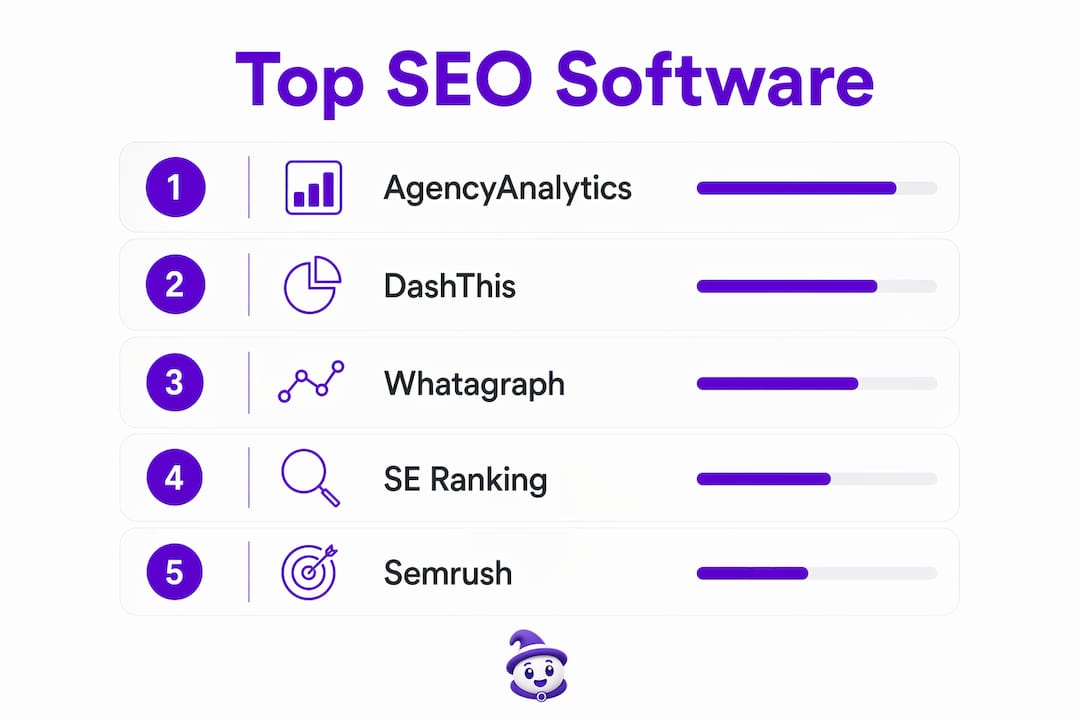
AgencyAnalytics is the most integration-rich option on this list, connecting to over 80 data sources including Google Search Console, Google Ads, Facebook, and Shopify. Agencies can build fully branded client dashboards, schedule automated PDF reports, and set up white-label portals where clients log in under the agency's domain. The rank tracker updates daily, and the drag-and-drop report builder requires no technical knowledge to produce professional outputs.

The pricing model charges per campaign rather than per seat, which suits agencies with a large number of small clients. The platform's automated reporting covers the full cycle from data pull to branded delivery, with minimal manual intervention once templates are configured.
Pros: Extensive integrations, strong white-label, automated scheduling, good client portal experience. Cons: Per-campaign pricing escalates for larger client rosters; some advanced SEO metrics require connecting third-party tools.
DashThis
DashThis specialises in one thing: getting a clean, automated report in front of a client with as little friction as possible. Its template library covers SEO, PPC, social, and email, and the drag-and-drop builder lets agencies assemble custom dashboards quickly. White-label branding is available on all paid plans, and reports can be scheduled for automatic delivery by email.

The platform connects to 34+ data sources, which covers the essentials but falls short of AgencyAnalytics or TapClicks for agencies managing complex multi-channel campaigns. If your priority is speed and simplicity over depth, DashThis delivers. Agencies looking for DashThis alternatives with more AI-driven features may find the market has moved on.
Pros: Fast setup, clean UI, good white-label, reliable scheduling. Cons: Fewer integrations than competitors; limited native SEO analysis depth.
Whatagraph
Whatagraph earns its place through visual clarity. Client reports look genuinely polished, which matters when your contact is a marketing director who skims rather than reads. Cross-channel data pulls automatically, and scheduled delivery means reports land in inboxes without anyone pressing send. The platform suits agencies whose clients respond better to charts and summaries than to raw data tables.
The entry price is higher than most alternatives, which makes it harder to justify for smaller agencies or freelancers. For mid-to-large agencies where client presentation quality is a competitive differentiator, the cost is defensible.
Pros: Excellent visual design, strong automation, cross-channel coverage. Cons: Expensive relative to feature set; limited SEO-specific depth.
SE Ranking
SE Ranking packs genuine agency-grade features into a price point that undercuts most competitors. The white-label module lets agencies brand the entire platform, including client-facing portals and PDF reports. The rank tracker covers Google and Bing, updates daily, and now includes AI overview monitoring, which tracks whether a client's content appears in Google's AI-generated search summaries. That feature alone sets SE Ranking apart from tools that have not yet adapted to the post-AI-overview search environment.
The site audit, keyword research, and backlink analysis tools are solid rather than exceptional. SE Ranking works best as a primary reporting platform for agencies that do not need the raw data depth of Semrush or Ahrefs.
Pros: Affordable white-label, AI overview monitoring, daily rank tracking, good agency features. Cons: Backlink index smaller than Ahrefs or Semrush; some advanced features require higher-tier plans.
Semrush
Semrush is the most complete SEO platform on this list, and its reporting capabilities reflect that breadth. The My Reports module lets agencies build custom PDF reports from any data point in the platform, including keyword rankings, backlink profiles, site audit findings, and competitor comparisons. The platform's AI overview tracking, position tracking, and content audit tools feed directly into client-ready report templates.
The limitation is that Semrush is primarily an SEO research and analysis tool that also does reporting, rather than a reporting-first platform. Agencies using it as their main client report tool will spend time configuring templates that DashThis or AgencyAnalytics handle out of the box.
Pros: Unrivalled data depth, AI overview tracking, strong competitor intelligence. Cons: Not reporting-first; setup time is higher; cost is significant for smaller agencies.
Ahrefs
Ahrefs remains the gold standard for backlink analysis, and its rank tracker and site audit tools are genuinely excellent. For agencies whose client reports centre on link building progress and organic visibility, Ahrefs provides data that no other tool on this list matches in depth or accuracy. The reporting module allows export of key metrics, but there is no native white-label option, which means Ahrefs works best as a data source feeding into a dedicated reporting platform rather than as a standalone client report tool.
Pros: Best backlink data, accurate rank tracking, strong site audit. Cons: No white-label reporting; not designed as a client-facing report platform.
Moz Pro
Moz Pro's Domain Authority metric remains one of the most recognised indicators in client conversations, which gives it a communication advantage that pure data tools lack. The rank tracker, site crawl, and link explorer cover the core reporting needs, and the platform's interface is approachable for agencies whose clients occasionally log in directly. Reporting exports are clean but not as automated or white-label-ready as AgencyAnalytics or DashThis.
Pros: Trusted brand metrics, good rank tracking, accessible interface. Cons: Reporting automation is limited; no white-label; data depth trails Semrush and Ahrefs.
Databox
Databox functions as a connector layer, pulling data from over 100 sources into customisable dashboards and scorecards. For agencies managing clients across Google Analytics, HubSpot, Salesforce, and multiple ad platforms simultaneously, Databox's flexibility is hard to match. Goal tracking and performance alerts add a layer of proactive reporting that most SEO-specific tools lack.
The free tier is genuinely useful for small agencies or freelancers testing the platform. Agencies looking for Databox alternatives with more AI-driven narrative generation may find the platform's reporting outputs require more manual commentary than they would like.
Pros: Exceptional connector breadth, flexible dashboards, goal tracking, free tier available. Cons: Requires manual narrative; not SEO-specific; white-label is limited on lower plans.
Swydo
Swydo combines PPC and SEO data in a single white-label reporting platform, which suits agencies managing both channels for the same clients. Automated report scheduling, custom branding, and a clean template library make it a practical choice for agencies that want to consolidate reporting without investing in a complex enterprise platform. The integration list covers Google, Facebook, LinkedIn, and the major SEO data sources.
Pros: PPC and SEO combined, strong white-label, good automation, competitive pricing. Cons: Fewer integrations than AgencyAnalytics; limited advanced SEO analysis.
Raven Tools
Raven Tools covers SEO, social, and PPC reporting in one platform, with custom report templates that agencies can brand and schedule. The site auditor, rank tracker, and backlink explorer feed into a report builder that handles multi-channel outputs without requiring separate tools. For agencies that want a single platform covering multiple channels at a mid-market price, Raven Tools is a practical option.
Pros: Multi-channel coverage, custom templates, white-label, competitive pricing. Cons: Interface feels dated compared to newer platforms; data depth is moderate.
TapClicks
TapClicks positions itself as a marketing operations platform rather than a pure reporting tool, which means it handles data ingestion, workflow automation, and client reporting in a unified system. Large agencies managing complex multi-channel campaigns across dozens of clients benefit most from its unified data management. Pricing is custom, which reflects its enterprise positioning.
Pros: Unified data management, strong automation, suited to large-scale operations. Cons: Custom pricing makes budgeting difficult; overkill for smaller agencies.
Serpstat
Serpstat offers rank tracking, site audit, keyword research, and competitor analysis at a price point that suits agencies watching their software spend. The white-label reporting module is included on higher plans, and the platform's all-in-one positioning means agencies can reduce the number of tools in their stack. The backlink index is smaller than Ahrefs or Semrush, but for agencies whose clients do not require deep link analysis, Serpstat covers the essentials.
Pros: Cost-effective, all-in-one, white-label available, good competitor analysis. Cons: Smaller backlink index; reporting automation is less polished than dedicated platforms.
SpyFu
SpyFu's strength is competitor intelligence. Agencies can pull a client's competitors' keyword histories, PPC spend estimates, and ranking trajectories, then fold that data into client reports to contextualise performance. The reporting outputs are functional rather than visually polished, and there is no white-label option. SpyFu works best as a supplementary data source rather than a primary reporting platform.
Pros: Excellent competitor data, affordable, useful for benchmarking reports. Cons: No white-label; limited automation; not a full reporting platform.
Ubersuggest
Ubersuggest suits cost-conscious agencies or freelancers who need keyword research and basic traffic estimates without a large monthly outlay. The reporting features cover rank tracking and site audit basics. For agencies with straightforward client reporting needs and limited budgets, it covers the fundamentals. Agencies with more demanding clients will outgrow it quickly.
Pros: Very affordable, easy to use, covers keyword and audit basics. Cons: Limited depth; no white-label; not suited to complex agency reporting.
Screaming Frog SEO Spider
Screaming Frog SEO Spider is the tool technical SEO specialists reach for when they need to crawl a site and surface every structural issue. The outputs are detailed and accurate, covering broken links, duplicate content, redirect chains, and page metadata at scale. The annual licence costs £259, which makes it one of the most cost-effective technical tools available. The limitation for client reporting is that its outputs are raw data exports rather than polished reports, so agencies typically use it as a data source feeding into a separate reporting platform.
Pros: Unmatched technical crawl depth, affordable annual licence, highly configurable. Cons: Raw outputs require processing before client delivery; no white-label or scheduling.
SEO PowerSuite
SEO PowerSuite is a desktop application covering rank tracking, link building, site audit, and reporting in four separate modules. Agencies that prefer owning their software rather than paying monthly subscriptions will find the annual licence model attractive. The white-label reporting module produces branded PDF reports, and the local SEO features are more developed than most cloud-based competitors. The desktop-only nature means collaboration across distributed teams is less straightforward.
Pros: Desktop ownership model, white-label, local SEO focus, comprehensive toolset. Cons: Desktop-only limits team collaboration; interface is less modern than cloud platforms.
StoryChief
StoryChief targets content-driven agencies that need to connect content production with SEO performance data. The platform combines a content calendar, multi-channel publishing, and SEO analytics in one place, which suits agencies where content strategy and SEO reporting overlap significantly. The reporting features are less developed than dedicated reporting platforms, but the content-to-performance connection is genuinely useful for agencies pitching content ROI to clients.
Pros: Content and SEO analytics combined, good for content agencies, clean interface. Cons: Reporting depth is limited compared to dedicated SEO platforms; no white-label.
AccuRanker
AccuRanker is built for one thing: fast, accurate daily rank tracking. The platform updates rankings on demand rather than waiting for a scheduled crawl, which matters when clients ask about position changes after a site update or algorithm shift. The reporting module produces clean client-facing outputs, and white-label options are available. For agencies whose clients are particularly focused on ranking positions, AccuRanker's speed and accuracy justify the higher price point.
Pros: Fastest rank updates, accurate data, white-label, clean reporting. Cons: Rank tracking only; no site audit, backlink, or keyword research tools.
AIclicks.io
AIclicks.io addresses a gap that most established SEO tools have been slow to fill: tracking a brand's visibility within AI-generated search results. The platform monitors AI citation rates, GEO (Generative Engine Optimisation) metrics, and branded query appearances in tools like ChatGPT and Perplexity. For agencies whose clients are asking about AI search visibility, AIclicks.io provides data that no other tool on this list covers in the same depth. Pricing is custom, reflecting its specialist positioning.
Pros: Purpose-built for AI visibility metrics, covers GEO tracking, forward-looking data. Cons: Niche focus; custom pricing; does not replace a full SEO reporting platform.
Sitechecker
Sitechecker suits freelancers and smaller agencies that need site monitoring, basic rank tracking, and audit reporting without the complexity of enterprise platforms. The interface is approachable, the white-label option is available on paid plans, and the monitoring alerts notify agencies when a client's site changes in ways that affect SEO. For straightforward client reporting at a modest price, it covers the basics reliably.
Pros: User-friendly, white-label available, good monitoring alerts, affordable. Cons: Limited depth for larger agencies; rank tracking is less accurate than AccuRanker.
Google Analytics
Google Analytics (GA4) is the foundation of almost every client SEO report, providing traffic, behaviour, and conversion data that no other free tool matches. Its native integration with Google Search Console adds organic search data directly to the reporting layer. The limitation is that GA4 requires configuration and interpretation before it produces client-ready outputs. Most agencies use it as a data source feeding into a dedicated reporting platform rather than as a standalone client report tool.
Pros: Free, authoritative traffic data, Search Console integration, widely understood by clients. Cons: Requires significant setup; not a reporting platform; GA4 interface has a steep learning curve.
Pro Tip: Connect Google Analytics and Google Search Console to your chosen reporting platform before building any client templates. This single step eliminates the most common data gap in client SEO reports and ensures organic traffic and ranking data appear in the same view.
How to choose the right SEO reporting software for your agency
The decision comes down to what your clients actually need to see, not what the software can theoretically produce. An agency running technical SEO campaigns for e-commerce clients has different reporting requirements than one focused on content strategy for professional services firms.
Work through these criteria before committing to a platform:
Automation level: Can the platform pull data, build the report, and deliver it to the client without manual intervention? Full automation is the standard for agencies managing more than five clients.
White-label capability: If clients see your agency's branding rather than the tool's logo, the report reinforces your value. This is non-negotiable for most agency relationships.
Integration breadth: Your reporting platform needs to connect to every data source your clients care about, including Google Analytics, Search Console, Google Ads, and any CRM or e-commerce platform in use.
Data accuracy and update frequency: Daily rank tracking matters for clients who monitor positions closely. Weekly or on-demand updates suit most content-focused campaigns.
Customisation: Can you tailor the metrics, layout, and narrative sections to match each client's priorities? A one-size-fits-all template rarely serves a diverse client roster well.
Ease of use: A platform your team finds frustrating to use will produce worse reports than a simpler tool used confidently. Factor in onboarding time.
Pricing model: Per-campaign pricing suits agencies with many small clients; per-seat pricing suits larger teams with fewer accounts. Run the numbers for your specific roster before signing up.
Support quality: When something breaks before a client presentation, response time matters. Check whether the vendor offers live chat or phone support on your plan.
AI and future-proofing: Platforms that already track AI overview appearances and AI citation rates will save you from switching tools in twelve months as these metrics become standard client expectations.
Transparent SEO reporting that acknowledges negative trends, rather than hiding them, consistently builds stronger client retention than reports that only surface good news. Build that principle into your template design from the start.
Pro Tip: Match your reporting cadence to your client's decision-making cycle. A monthly strategic report paired with a weekly automated snapshot suits most agency relationships. The monthly report carries the narrative; the weekly snapshot answers the "how are we doing?" question without a call.
How we selected and reviewed these SEO reporting tools
Every tool on this list was assessed against a structured set of criteria rather than ranked by popularity or marketing spend. The evaluation draws on direct experience with digital project management and SEO across agency and in-house environments, combined with third-party user feedback from platforms including G2 and Capterra.
The scoring framework covered:
Feature completeness: Does the platform cover the core reporting needs of a UK agency in 2026, including rank tracking, site audit data, and traffic integration?
Automation capabilities: How much manual work does the platform eliminate from the reporting cycle?
White-label and customisation: Can agencies brand and tailor reports to individual client needs?
Integration quality: Do the data connections work reliably, and do they cover the sources UK agencies most commonly use?
Pricing transparency: Is the pricing model clear, and does it scale reasonably for agencies at different sizes?
User feedback: What do verified users report about reliability, support responsiveness, and real-world usability?
AI and 2026 relevance: Does the platform address emerging requirements around AI visibility metrics and automated narrative generation?
Tools were included because they appear consistently in agency conversations, have demonstrated industry credibility, or address a specific gap in the market that other platforms do not cover. Screaming Frog SEO Spider, for example, is not a client reporting platform in the traditional sense, but its role in technical audit workflows makes it relevant to any agency building comprehensive client reports.
The 2026 focus reflects a genuine shift in what clients expect. AI visibility metrics including branded query volume and AI citation rates are moving from optional additions to expected components of a thorough client SEO report.
Trends and best practices in SEO client reporting for 2026
The most important shift in client reporting right now is not a new tool. It is a change in what clients ask about. AI-generated search results have introduced a new layer of visibility that traditional rank tracking does not capture. Clients whose content appears in Google's AI overviews, or gets cited by ChatGPT and Perplexity, want to see that data alongside their organic rankings. AI visibility metrics now include branded query volume, AI citation rate, and referrals from AI-powered search tools, and agencies that track these metrics are having more productive client conversations than those that do not.
The structure of the report itself matters as much as the data inside it. Effective SEO reports exclude raw tool screenshots and instead feature narrative summaries with contextual interpretation tailored to the client's level of sophistication. A technical SEO audit finding means something different to a developer than to a managing director, and the report should reflect that difference.
Monthly reporting with weekly snapshots suits most agency engagements. The monthly report carries the strategic narrative; the weekly automated snapshot answers routine questions without consuming account manager time. This hybrid model has become the practical standard for agencies managing more than a handful of clients.
The framing of negative data is where many agencies lose client confidence. Transparency about negative trends builds trust more reliably than selective reporting. When rankings drop or traffic falls, the report should explain why, what the agency is doing about it, and what the client should expect next. That structure, sometimes called the PAS arc (Progress, Attention, Strategy), turns a difficult conversation into a demonstration of expertise.
Most reports fail because they address analysts rather than decision-makers. The fix is a CEO Translation Layer: lead with the business outcome, not the technical metric. "Organic traffic generated an estimated 47 new enquiries this month" lands differently than "organic sessions increased 12%." Both are true; only one drives the conversation forward.
Automation handles data assembly and visualisation well, but human commentary remains the part that clients actually read. The platforms that produce the best client outcomes are those where automation handles the data layer and the account manager adds the narrative layer. The report is evidence of the work done, not the product itself. Agencies that treat reporting as a byproduct of continuous SEO work, rather than a monthly deliverable to produce from scratch, consistently produce better reports with less effort.
Pro Tip: Turn your monthly report into a growth tool by linking every SEO activity directly to a business outcome. If you built ten links this month, show the estimated traffic value of the pages they point to. If you fixed a crawl issue, show the pages that are now indexing correctly. Clients who see the connection between activity and outcome are far less likely to question the retainer.
Mycontentlab: AI-powered reporting without the manual grind
Most of the tools reviewed here solve one part of the reporting problem well. Mycontentlab approaches it differently, connecting 20+ analytics, paid, and social platforms into a single reporting layer and then using AI to turn that data into client-ready reports, content ideas, and campaign recommendations.
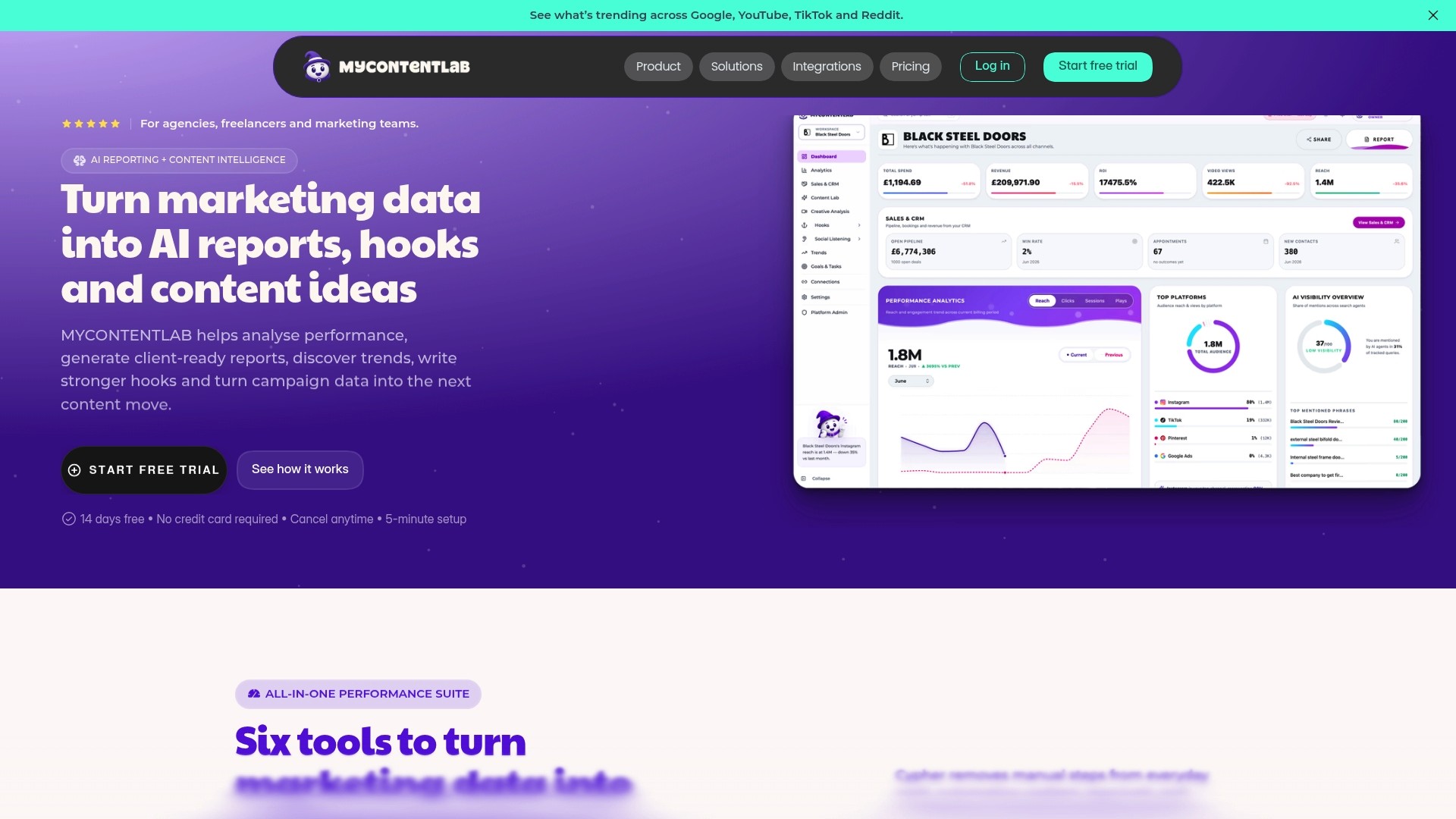
For agencies and in-house teams that spend too much time assembling reports and not enough time acting on them, Mycontentlab's AI-powered analysis converts scattered metrics into coherent narratives without requiring a copywriter to finish the job. White-label options, tiered subscription plans scaled to agency size, and real-time data connections mean the platform grows with your client roster rather than against it. If you want to see how automated client reporting works in practice, Mycontentlab offers a clear starting point for agencies ready to move beyond manual assembly.
FAQ
What is the best SEO reporting software for agencies in the UK?
AgencyAnalytics, DashThis, and SE Ranking are the strongest choices for most UK agencies, offering white-label reporting, automation, and broad integrations at different price points. The right fit depends on client volume, budget, and whether AI visibility metrics are a priority.
How often should agencies send SEO reports to clients?
Monthly reports with weekly automated snapshots suit most agency engagements. Monthly reports carry the strategic narrative; weekly snapshots answer routine performance questions without consuming account manager time.
Do SEO reporting tools include AI visibility metrics?
A growing number do. SE Ranking tracks AI overview appearances, and AIclicks.io specialises in AI citation rates and GEO metrics. AI visibility metrics including branded query volume and chatbot referrals are becoming standard components of client SEO reports in 2026.
Can Mycontentlab replace a dedicated SEO reporting platform?
Mycontentlab connects 20+ platforms and uses AI to generate client-ready reports and content recommendations, making it a strong option for agencies that want reporting and content intelligence in one place. It complements rather than replaces deep SEO analysis tools like Semrush or Ahrefs.
What should a client SEO report always include?
Effective client SEO reports cover organic traffic trends, keyword ranking changes, technical health updates, and a narrative summary that connects SEO activity to business outcomes. Raw data exports and tool screenshots without context are the most common reasons clients disengage from reports.
Key takeaways
The strongest SEO reporting software for clients in 2026 combines automated data assembly with white-label customisation and, increasingly, AI visibility tracking that goes beyond traditional rank positions.
Point | Details |
|---|---|
Automation is the baseline | Any platform that requires manual data assembly for each report is costing your agency time it cannot bill. |
White-label is a client retention tool | Branded reports reinforce agency value at every touchpoint; choose a platform that supports full white-labelling. |
AI visibility metrics are now expected | Track branded query volume, AI citation rates, and AI overview appearances alongside traditional KPIs. |
Reports should address decision-makers | Lead with business outcomes, not technical metrics; the CEO Translation Layer turns data into client buy-in. |
Mycontentlab for AI-driven reporting | Mycontentlab connects 20+ platforms and uses AI to generate client-ready reports and content recommendations from real performance data. |
Recommended

Jul 19, 2026


Search



You can also read
Category
All
Compare
Marketing Reporting
Agency Operations
Content Intelligence
Brand Monitoring
Platform Reporting